
What Kind of Game Is P.A.T.H.: Vietnam?
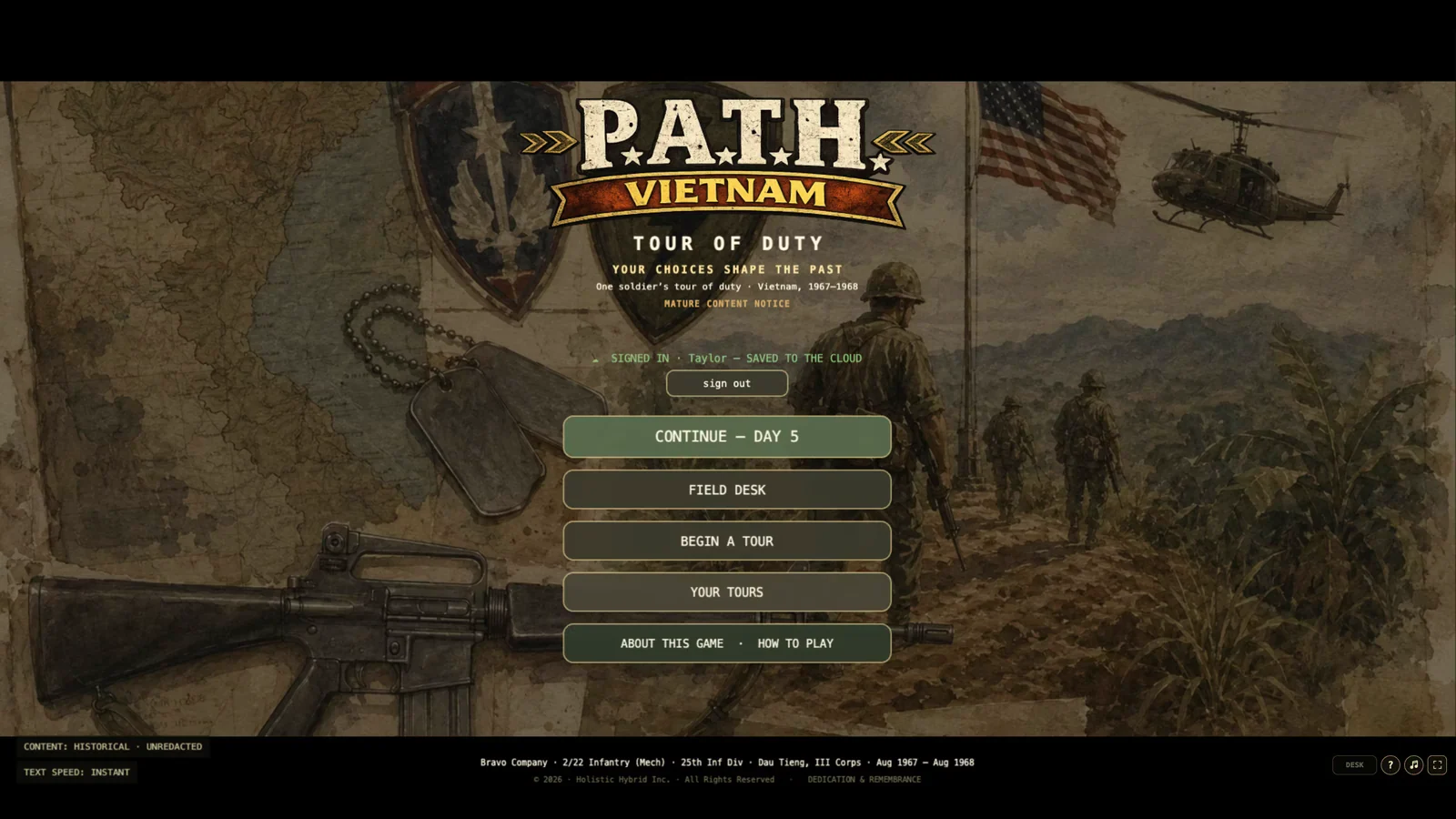
P.A.T.H.: Vietnam is easiest to describe by starting with what it is not.
It is not a first-person shooter. It is not a game about collecting territory, building an army, or turning a historical war into a clean ladder of victories. It does contain operations, danger, weapons, and combat, but those things sit inside a larger experience: one soldier's tour from 1 August 1967 to 1 August 1968.
The player joins Bravo Company, 2nd Battalion, 22nd Infantry (Mechanized), the “Triple Deuce,” based at Dau Tieng. From there, the tour unfolds one day at a time. Some days carry the weight of recorded events. Some involve patrols, road-security work, watches, maintenance, or sudden contact. Many are built from smaller pieces: a letter, a meal, a conversation, a wet pair of socks, a radio broadcast, a purchase from the PX truck, or a photograph kept for later.
The game is about the accumulation of those days.
A life-history game
I use the phrase “life-history game” because it places the emphasis where it belongs. Your character is not only a set of combat abilities. He has a home, a background, strengths, weaknesses, a job, relationships, and an idea of what might happen after the Army. The tour tests all of it.
That does not mean the game is a passive story. Your choices matter constantly. They shape how you spend time, what you carry, who you know, how prepared you are, and how your character changes. The difference is that P.A.T.H.: Vietnam does not reduce every decision to a visible good-or-evil score.
You may help someone because it is right, because your character is capable, because your squad needs trust, or because you simply cannot walk away. You may rest instead of taking on more work because exhaustion has consequences. You may buy a camera rather than another comfort because you want a record of the tour. The game remembers without always interrupting to announce that it is remembering.
Four shifts, hundreds of days
Each day is divided into Dawn, Day, Dusk, and Night. A morning event establishes the atmosphere or brings the outside world closer. The Action Board then gives you ways to spend time. Major actions are the substantial work of the day: details, watch, recovery, and duties that consume real effort. Minor actions hold the human rhythm around that work: writing home, talking with a squadmate, cleaning a weapon, reading, taking a photograph, tuning the radio, or visiting a resupply truck when one is available.
This structure makes room for contrast. A quiet dusk matters more when the player knows that the next day may not be quiet. A tense patrol matters more when the people beside you have become familiar over weeks of ordinary life.
The game does not need every day to become a dramatic set piece. In fact, doing that would flatten the tour. Boredom, routine, anticipation, and the count toward home are part of the design. The calendar is not decoration. It is one of the game's central characters.
Rules beneath the surface
P.A.T.H.: Vietnam is adapted from a deep tabletop roleplaying system. The digital game carries that structure underneath the scenes. Your soldier has four attributes, Coolness Under Fire, twelve skills, a military role, a specialty, and equipment that can help when it is actually carried.
Skills use a step-die ladder. Better training means a stronger die, but the player is not asked to stop the story and perform the mathematics. The engine handles the roll. You make the decision; the game returns the consequence.
The same philosophy applies to stress, morale, and trust. These are real systems, but they are meant to be felt through the fiction rather than watched as three brightly coloured bars. A frayed character behaves differently. A squad with stronger bonds responds differently. A village treated fairly may remember. The Service Record and nightly journal help the player understand the pattern without making every moment feel like accounting.
The Field Desk
At almost any point, you can open the Field Desk. It is the practical and emotional centre of the game.
The Service Record shows the soldier the Army sees: attributes, skills, rank, training, upkeep, load, and time remaining. The Medal Rack records official recognition. Kit & Inventory shows what is carried and what remains at camp. The Photo Album preserves selected images. The Journal & Tour Log hold both the automatic record and the player's private words. The Calendar makes the length of the year visible.
Other sections turn military life outward. Finance tracks pocket money, savings, support sent home, and informal squad loans. The Catalogue allows a gift to be ordered for someone far away. The Grunt's Dictionary helps with the language of the period. A fully recreated Pocket Guide to Vietnam can be opened and searched as an artifact rather than reduced to a decorative cover. The radio brings in a world that keeps moving even while the player is far from it, through original PATH music, fictional station voices, news-format pieces, announcements, and programmes that unlock with the tour calendar.
The desk also keeps Audio separate from Accessibility & Sensitivity. Text size and speed, content treatment, motion, flashing, and decision pressure can be adjusted without changing the soldier's authored consequences. These are not afterthoughts attached to the experience. They are part of how the player chooses to approach it.
These are not bonus menus attached to the “real” game. They are the real game. The patrol and the footlocker, the firefight and the letter, the medal and the delay before it is presented all belong to the same life.
No simple winning
There is no traditional score and no clean victory screen. The immediate goal is to complete the tour and reach the Freedom Bird home, but survival alone does not describe the whole result.
Who did your character become? Which relationships endured? What skills were learned in the field? What was lost? What did the record say, and what did the journal say that the record could not?
Some players will approach P.A.T.H.: Vietnam as a historical roleplaying game. Others will see a slow strategy game about time, risk, and preparation. Some will be drawn to the material culture—the radio, the kit, the catalogue, the photographs. Others will care most about the squad and the road home.
All of those readings are welcome. The game is built to let large history and small personal choices occupy the same day.
If that sounds quieter than the usual war game, it is. Quiet does not mean uneventful. It means the game leaves enough space for the player to notice what the noise would otherwise cover.