Five Years at the Table: Giving P.A.T.H.: Vietnam a Year of Focus
P.A.T.H.: Vietnam did not begin this year. It began during the COVID period as a tabletop role-playing project I kept returning to whenever work, life and energy allowed. Sometimes I worked on it steadily. Sometimes it sat untouched. Sometimes I opened an old section and discovered that the person who had written it had created three new problems for the person trying to edit it.
That person was also me.
Over roughly five years I researched, drafted, reorganized, expanded and fact-checked the game. I produced far more material than a player should ever be asked to read. I made mechanical systems that looked impressive in a document and felt awkward at the table. I wrote passages whose tone no longer seemed right when I returned to them. I found errors in details I thought I understood. I changed my mind about what the game was actually trying to do.
The work was not wasted. It became the foundation.
A difficult subject does not reward certainty
A historical game about Vietnam raises questions that cannot be solved by adding more equipment tables.
Whose experience is the game following? What does the player control, and what should remain outside that control? How can choices matter without suggesting that one fictional soldier can repair history? How should injury, fear, loyalty, boredom, humour, prejudice, friendship and loss appear without becoming spectacle? When does detail create understanding, and when is it simply decoration?
Those questions changed the mechanics.
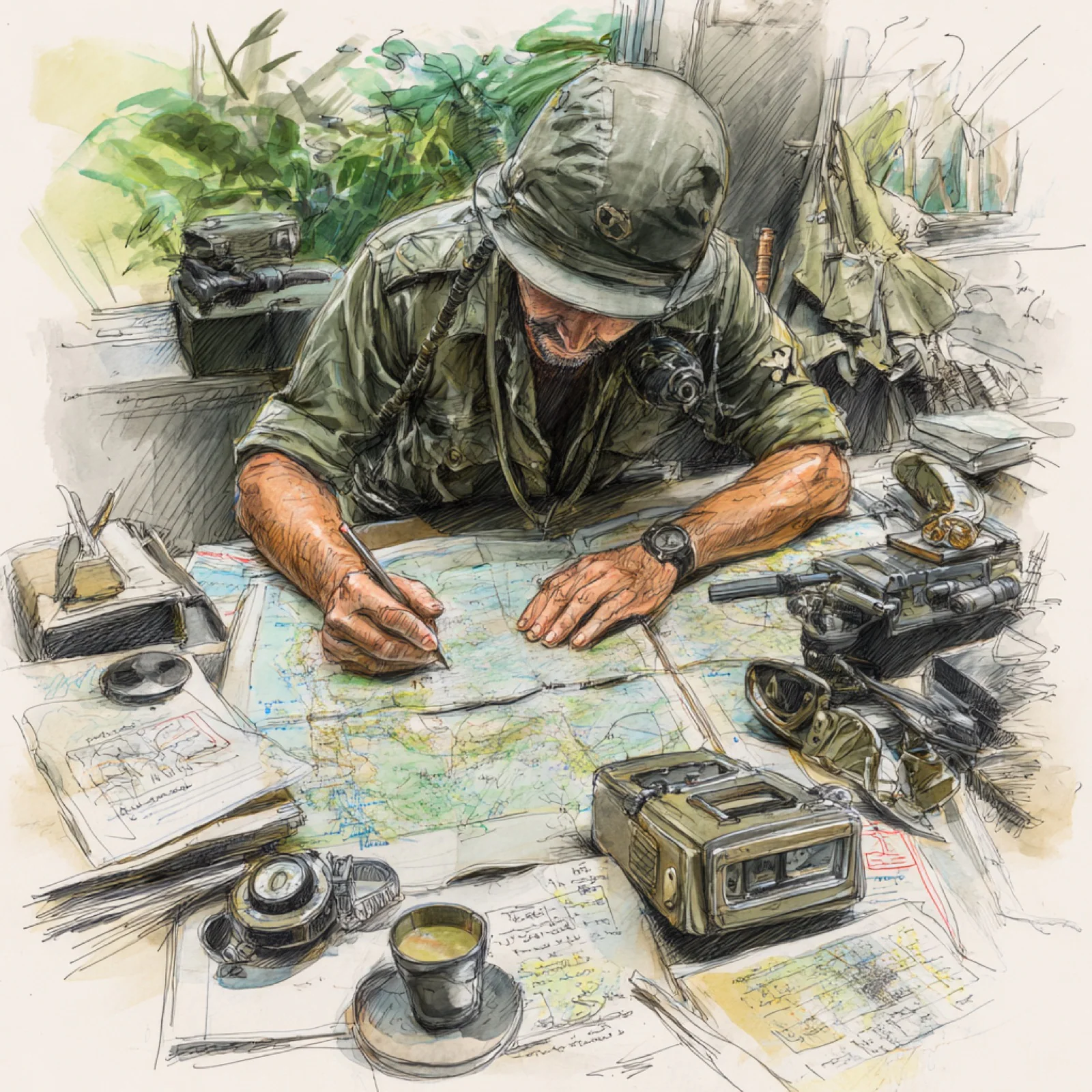
If a game is only about winning firefights, then weight is mainly a limit on combat efficiency. If it is about living through a tour, weight becomes part of fatigue, preparation and judgment. A radio is not merely a bonus. It is a responsibility. A letter is not flavour text. It can be a promise, a misunderstanding, a delay or a connection to a person whose life continued while the soldier was away.
The design slowly moved from a game about managing a campaign toward a game about carrying a life through one.
The mistakes became design material
Some mistakes were factual and required correction. Others were structural. I had systems that overlapped, chapters that explained the same rule differently and content whose confidence was greater than its evidence. I sometimes treated research notes as if they were finished writing. I sometimes expanded a weak idea because expansion felt easier than deciding whether it belonged.
The most useful editing question became simple: what experience is this rule protecting?
If I could not answer, the rule needed another look. Some rules were removed. Some were hidden beneath the player-facing experience. Some became tables for a tabletop referee but not controls for a player. Others turned into the beginnings of what I now call the P.A.T.H. System: a set of connected ideas about background, ability, pressure, consequence and the road a person takes through history.
P.A.T.H. stands for more than a title on a cover. The central idea is that history creates the conditions, but the player still has to decide how a person moves through them. That requires enough structure for consequences to be real and enough restraint for the system not to claim more authority than it has.
Manuals are milestones, not monuments
I now have a substantial private library of manuals, campaign material and research. It feels good to see the project occupy shelves and folders. It also creates a temptation to treat volume as completion.
A large manuscript can hide uncertainty remarkably well.
The manuals gave me something important: a place to collect the game’s language, mechanics, questions and boundaries. They also showed me where the project had become too broad. A complete game cannot be every campaign, every role, every year, every historical viewpoint and every possible mode of play at once.
The next step was not another hundred pages. It was a clearer decision.
A new-year promise to the project
Today’s private resolution is blunt: stop admiring the size of the idea and make something people can actually experience.
I needed to give the project a real year of attention. Not a year of endless expansion, and not a dramatic promise that everything would ship before December. A year of disciplined movement: choose a centre, test it, make mistakes in smaller batches, keep what survives and let the project become more specific.
The approaching Year of the Fire Horse became a useful personal rallying phrase. Let’s go—but go somewhere.
That distinction matters. Energy without direction had already produced a great deal of material. What I needed now was momentum with a purpose.
What I wanted to carry forward
I wanted to preserve the strongest parts of the tabletop work:
- a character whose life begins before the uniform;
- skills and limitations connected to background rather than a perfect build;
- a complete tour shaped by ordinary duties as well as major events;
- equipment that has weight, place, condition and meaning;
- relationships that continue across time instead of resetting after a scene;
- history that establishes the world without pretending the game itself is the historical source;
- consequences that may return long after the choice that created them;
- and an ending that reflects who came home, not only whether the final mission succeeded.
I do not yet know the final technology, platform or business model. I do not know which version of the game will become the right one. I do know that P.A.T.H.: Vietnam has accumulated enough foundation to deserve a serious attempt.
This first Dispatch is therefore not an origin myth. It is a workbench note. The project existed long before today, and I expect it to keep changing. January 8 marks the moment I am deciding to stop waiting for a perfectly clear road.
I had the research. I had the questions. I had a tabletop foundation full of useful ideas and visible mistakes.
The next job was to start walking.