
How Lucky 8 Works: A New Player’s First Roll
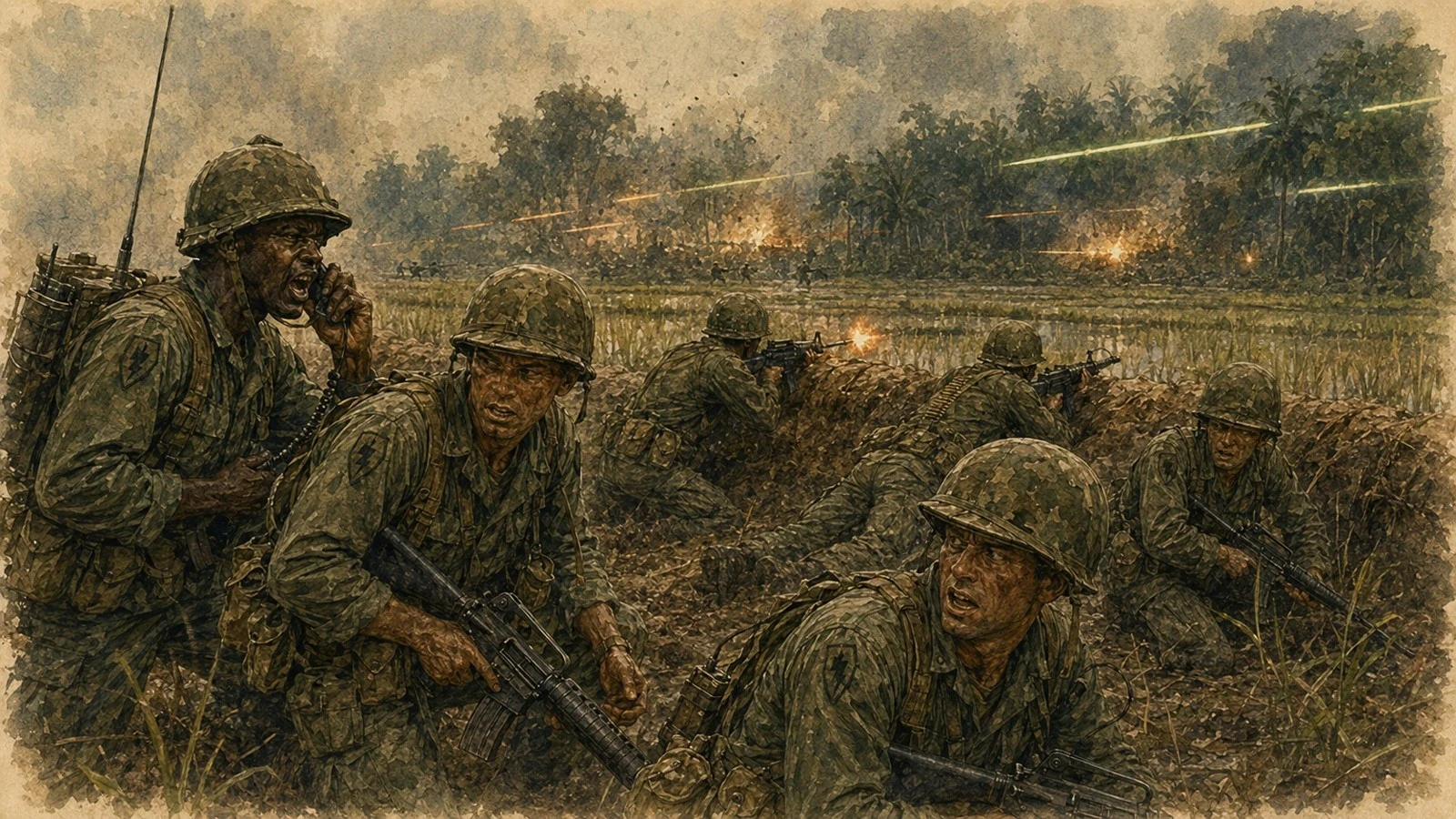
When I am working on a rules example, I have a useful test: could someone make this roll without me sitting beside them to explain what I meant? If not, I still have work to do. For P.A.T.H.: Vietnam (Pivotal Actions Through History), I want the first Lucky 8 roll to be something you can follow, question and try for yourself.
So let me walk through one. I put the conversation before the dice because it tells us what we are about to resolve. In P.A.T.H.: Vietnam, a player begins with an objective and a method. “Get the gun silent” is an objective. “Put a grenade through the firing slit from the dike” is a method. The method tells the table which abilities matter, whether the Soldier has the training and position to attempt it, and what will happen if it goes wrong.
First, decide whether this needs dice
I do not want dice interrupting every useful thing a Soldier does. A qualified Soldier who has time, tools and no meaningful uncertainty cleans a weapon, follows a known track, or performs ordinary duty. Rolling for routine competence would make people randomly bad at jobs they are trained to do.
Dice appear when three answers are yes: can this method work here; is this action actually the Soldier’s to attempt; and will success or failure change what happens next? If a method cannot work, Lucky 8 does not disguise that with an impossible Difficulty. The Narrator says what is missing: a qualified person, a tool, a route, more time, better information, or a different plan. That is not a refusal to play. It is the opening of the next scene.
Build the personal pool from a Stat and a Proficiency
Every Soldier has four Stats—PHYS, FIELD, TAC and COH—and sixteen Proficiencies. I choose the pair from the method. Starting with the player’s favourite rating tends to produce some very imaginative explanations for using it. Throwing a grenade is PHYS plus Weapons Handling; organising a casualty carry can be COH plus Medical Aid.
| Rating | Dice |
|---|---|
| 0–1 | 1d8 |
| 2–3 | 2d8 |
| 4–5 | 3d8 |
| 6–7 | 4d8 |
| 8 | 5d8 |
Add the Stat dice and Proficiency dice. That personal pool is capped at 8d8 and never drops below 1d8. A FIELD 3 Soldier with Marksmanship 2 brings 2d8 plus 2d8: four dice. A rating is competence, not permission. A Qualification is a named permission that opens an attempt; a Specialty is a completed school that supplies a package of EP and Qualifications. Neither is a secret dice bonus. LifeP.A.T.H.—Previous Activities, Training, History—gives those ratings and Qualifications a history. The roll uses what the record actually supplies.
Conditions remove dice. People can put them back.
Conditions name what is interfering with this action: rain, darkness, fever, lack of sleep, load, a wound, a jammed net. Each distinct relevant Condition removes dice according to severity: Adverse removes one, Severe two and Critical three. They are not capped, but an eligible attempt always retains its 1d8 floor. One cause is one Condition; rain does not become three penalties merely because it also makes the ground unpleasant.
Support is another person giving up their major action to make a specific contribution. Each capable helper adds +1d8, with a hard cap of +3d8 from coordinated Support. The helper needs to be present, capable and exposed to the same problem; “I help” is not enough. Rush is a declared effort in immediate danger. It gives +1d8 and charges FUBAR after the action: +1 for the first Rush, +2 and Unconscious for the second. Support and Rush can take a pool over eight dice because they represent what the Soldier’s own ratings do not: another person’s action and a cost paid in the body.
State the Difficulty and the cost before rolling
The Narrator says two things aloud: the Difficulty and the principal consequence of missing it. General Difficulties progress from 8 (easy but consequential) through 16, 24, 32 and up to 64 for career-defining undertakings. The number belongs to the job, not to the player. Do not raise it because a Soldier is capable or helped; do not use the same bad visibility as both a Condition and a higher Difficulty.
This is the part I do not want hidden from you. The consequence is the reason the roll matters: lost time, continued exposure, a missed opening, damaged equipment, or a worse position. It should be legible enough for a player to choose whether the risk is worth taking.
Roll every die, add every die, explode every natural 8
Roll the final pool together. Add all the faces. Nothing is retained and nothing is discarded. Every natural 8 explodes once: it scores eight, that die is rolled again, and the reroll is added. A second 8 on that reroll scores eight and stops. Equipment can improve one die when its own profile permits, but it cannot make a die natural and cannot create an explosion.
I use Reyes and a grenade throw in the Primer because it gives the roll one clear job. He wants to put the grenade through a bunker slit. PHYS 4 contributes 3d8 and Weapons Handling 2 contributes 2d8, so he rolls 5d8. He has the training, grenade and line to make the attempt. No one can spare an action for Support. The Narrator calls Difficulty 24 and says that a miss leaves the gun firing and the squad exposed.
Reyes rolls 8, 6, 5, 3, 1. The eight explodes once and rerolls as 4. His total is 27. He succeeds by three. The throw worked; the grenade’s later effects are resolved separately. A success at delivery is not a blank cheque for every possible outcome.
Then read Luck, without letting it rewrite the scene
Count only natural 8s from the acting Soldier’s own capped Stat-and-Proficiency pool after Conditions; Support and Rush dice explode but do not create personal Luck tiers. One eight is Lucky: a small concrete thing goes his way. Two is On a Roll: two small things or one larger one. Three or more is a Lucky Streak: the eights explode, one FUBAR clears, and the Narrator gives something concrete the Soldier did not ask for. The benefit must grow from the scene. It cannot manufacture training, permission, equipment, absent people or a different history.
The habit I want the example to teach
Say what you want. Say how you will do it. Ask what makes it possible, what it costs, and whether somebody can help. Then roll the pool the situation has earned. That is what I am trying to make readable: your choices can improve a chance before the dice are thrown, and the result changes the story without pretending that the world has stopped being real.
If you can explain where Reyes’s five dice came from, why the extra four was added, and why the throw does not settle everything the grenade does afterward, the example has done useful work. If one of those steps still feels awkward, that is exactly the sort of feedback I want. I would rather fix the explanation here than have it interrupt somebody’s first game.