Three Jobs That Hold the Tour Together
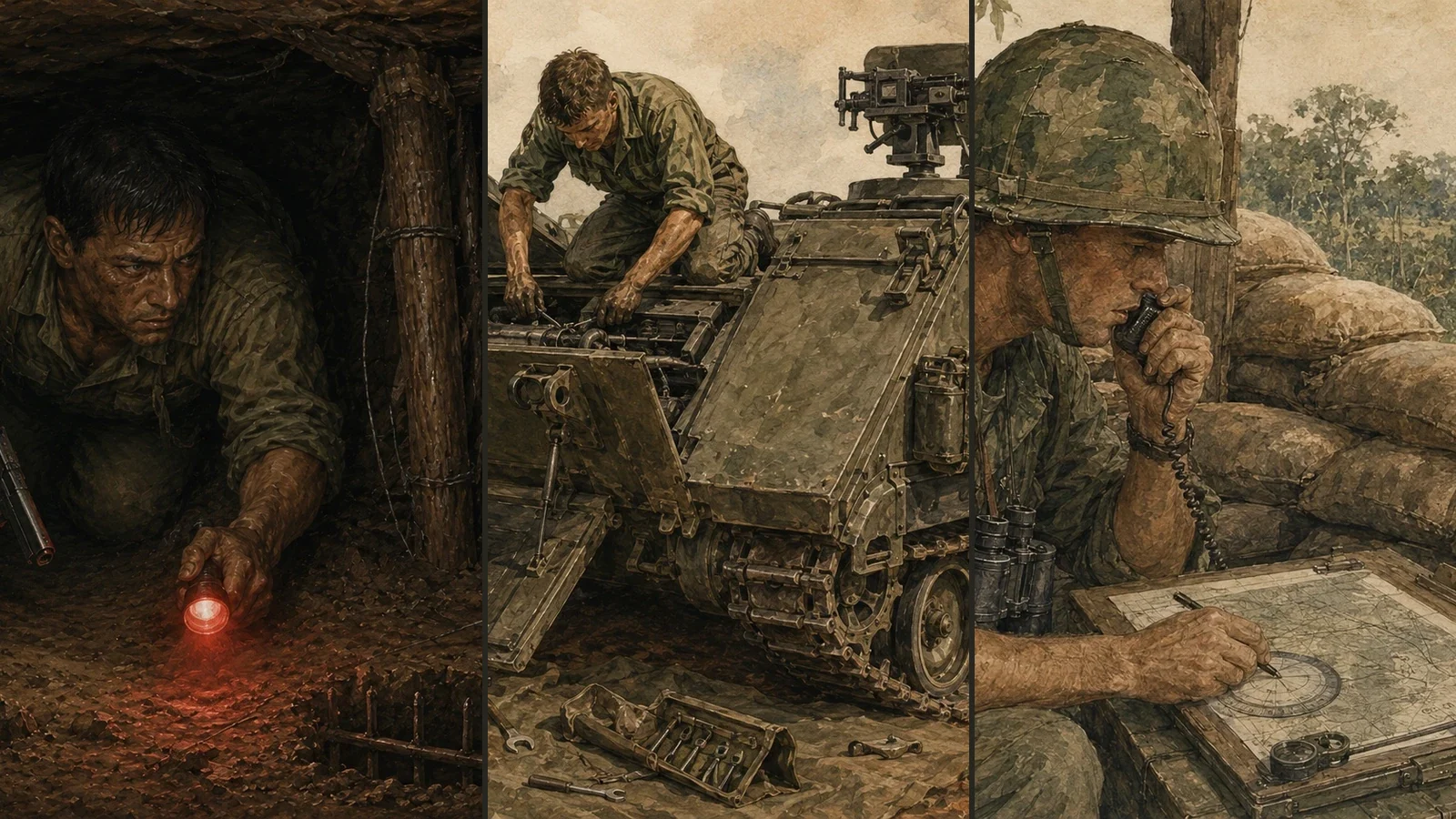
The Engineer, Mechanic, and Forward Observer do very different work. One reads hidden danger and changes terrain. One keeps vehicles and equipment alive. One connects observation on the ground to fire support at a distance.
What they share is easy to overlook: each role makes other people's actions possible.
These are excellent choices for players who enjoy responsibility without needing to be the visible centre of every scene. Their victories often appear as movement that continues, danger avoided, or support arriving where it was actually needed.
The Engineer: seeing what is hidden
The Engineer combines technical skill with reconnaissance. Roads, obstacles, mines, demolition work, and tunnels all demand more than bravery. They demand attention.
The specialty choices make that attention specific. Demolitions concerns the controlled use of destructive force. Mines and Booby-Traps focuses on devices designed to punish haste and routine. Tunnels move the problem underground, where space, information, and confidence all become scarce.
The Engineer's starting equipment reflects this range: weapon, demolition materials, detector, probe, and the ordinary kit required to function in the field. It adds up. A technical tool left at camp cannot solve a technical problem, but an overloaded Engineer may reach the problem tired and slow.
Choose the Engineer if you enjoy careful play. The role is not an invitation to blow up every obstacle. Often the most satisfying result is identifying the danger early, clearing a route, or understanding what the ground is telling you before anyone steps into the answer.
The Mechanic: preventing the dramatic scene
The Mechanic's natural habitat is a mechanized unit where vehicles carry people, equipment, protection, and the schedule itself. Tracks, engines, driving, and repair determine whether a plan survives contact with ordinary mechanical reality.
This can create a strange problem for game design: good maintenance prevents the dramatic breakdown. The better the Mechanic performs, the less likely everyone is to see the disaster he avoided.
P.A.T.H.: Vietnam treats that as a victory rather than an absence of content. A vehicle starts. A movement leaves on time. Damage is understood before it becomes failure. People come back because the machine can still move.
The Mechanic's specialties point toward Vehicles or Aviation, with the launch tour naturally giving mechanized work a strong home. Technical and Driving skills lead the sheet, supported by physical capability and ordinary combat training. The toolkit and repair equipment create another meaningful loadout question: the item most likely to save the day is not light.
Choose the Mechanic if you like practical puzzles and the material side of the tour. You may discover that the most emotional machine in the game is the one that brings everyone back inside the wire.
The Forward Observer: precision at a distance
The Forward Observer reads terrain, location, and the needs of the people nearby, then communicates with force that may be far away. The role combines Recon, Agility, Intelligence, communication, and command awareness.
Its equipment includes a radio, map board, and reference materials. None looks as powerful as the support the role can request. That gap is exactly where the responsibility lives.
Coordinates are not abstract when people occupy the ground. A good Forward Observer must know where friendly elements are, understand uncertainty, and communicate precisely. The role's two specialty choices—Fire Support Coordination and Forward Observer—emphasize either the larger relationship between available support and the unit or the immediate work of seeing and reporting from the ground.
Choose this role if you like maps, observation, and decisions whose effect arrives from beyond the screen. It suits a player comfortable with power that must be handled cautiously.
Three different relationships with equipment
These roles make a good comparison because their tools do not mean the same thing.
The Engineer's equipment interacts with hidden physical risk. The Mechanic's equipment restores or sustains a complex machine. The Forward Observer's equipment turns observation into communication. In each case, the tool helps only when it is carried, maintained, and used by someone with the right skill.
This prevents gear from becoming a simple inventory collection. Owning an item is not the same as having it at the moment of need. Having it is not the same as knowing how to use it. Knowing how to use it is not the same as having time and safety.
Before a movement, specialist players should inspect the Kit view with the day's purpose in mind. A detector, full toolkit, radio, maps, batteries, water, weapon, and protective gear all make valid claims. Strength, rucksack capacity, and the penalties for carrying too much turn those claims into a decision.
Life away from the specialty
No soldier works as a job title every hour.
The Engineer may spend a quiet evening writing home rather than thinking about wire. The Mechanic may take photographs of people instead of vehicles. The Forward Observer may tune the radio precisely because he wants sound that asks nothing from him.
Finance, mail, the journal, squad relationships, and the calendar prevent specialist roles from becoming narrow technical exercises. They also allow personality to cut across expectation. The cautious Engineer might be reckless with money. The practical Mechanic might keep the most sentimental Photo Album. The precise Forward Observer might struggle to describe his own feelings in a letter.
Those contradictions are where an archetype becomes a character.
Which responsibility belongs to you?
Choose the Engineer when you want to confront danger hidden in terrain and objects. Choose the Mechanic when you want to understand how the unit keeps moving. Choose the Forward Observer when you want to connect close observation to distant consequence.
All three roles reward players who can appreciate an outcome that does not need applause. The road is open. The track keeps moving. The support lands where intended.
The tour holds together for one more day, and your job is part of the reason.