
How to Read Your Service Record
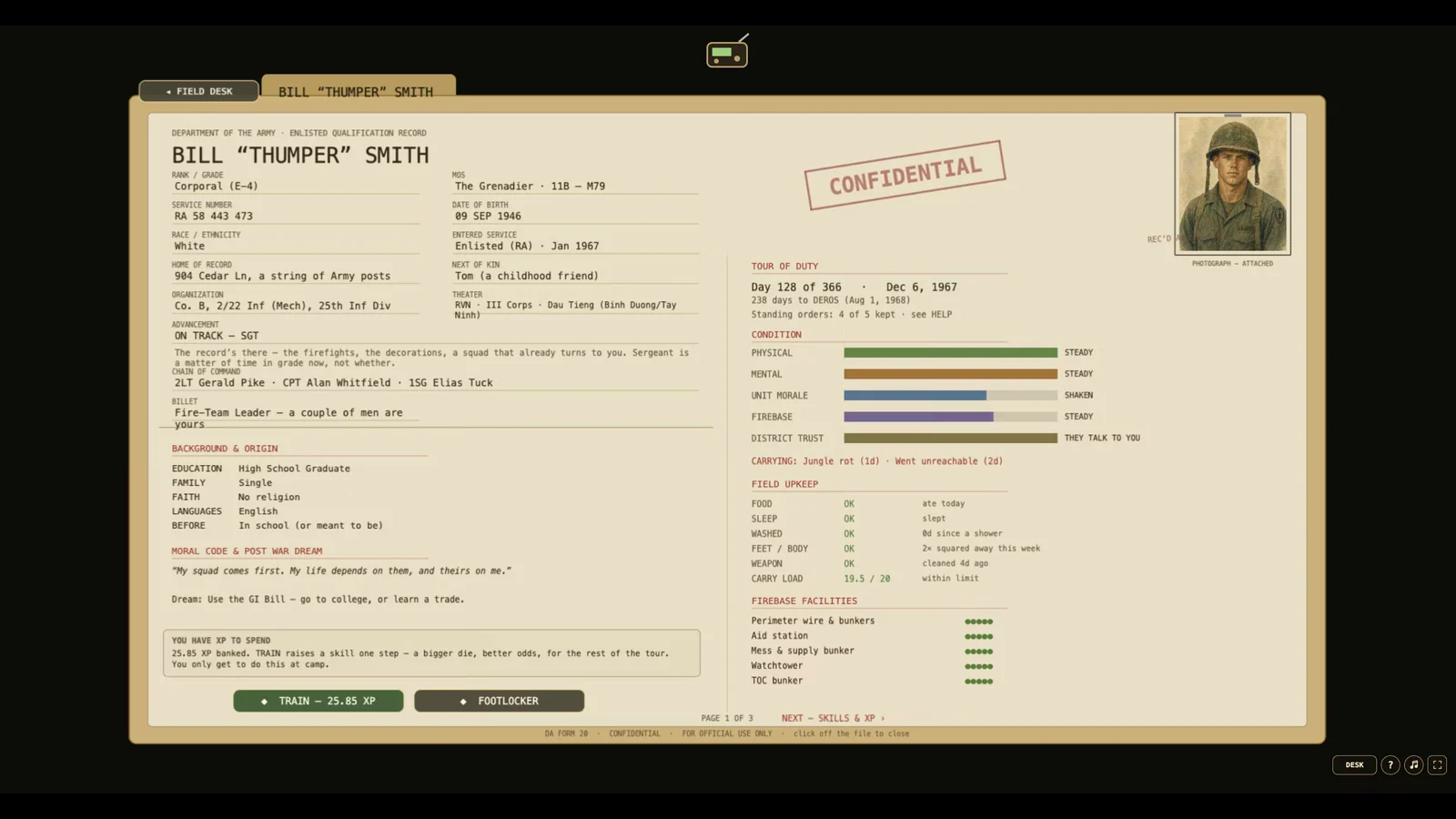
The Service Record is the most concentrated view of your character in P.A.T.H.: Vietnam. It can look like a sheet of Army paperwork because that is part of its purpose. It is also a practical dashboard for the player.
You do not need to read every field each time it opens. Learn to use it in layers: identity, capability, condition, load, growth, and time.
Identity: the person and the role
At the top is the soldier the game has been following: name, portrait, rank, role, and the details established through LifeP.A.T.H. This is a useful place to pause after the opening hours. The character may already feel different from the person you imagined during creation.
Role and specialty explain the military foundation. The Grunt may be trained as a Point Man. The Medic may focus on Trauma Care. The Mechanic may lean toward Vehicles. The specialty is worth remembering because its benefit applies only in relevant situations. It is not a universal badge.
The record also shows active gear bonuses. “Active” matters. Owning a useful item does not help when it is sitting in the footlocker. If an expected bonus is missing, the Kit view is the first place to look.
Capability: attributes and skills
The four attributes—Strength, Agility, Intelligence, and Empathy—describe broad capacity. Skills describe trained application.
Ratings use a step ladder. Better ratings mean larger dice. The digital engine handles the actual roll under the story, so the Service Record is less about calculating a percentage and more about understanding relative confidence.
A high skill is where the character has been prepared to act. A low skill is a real limitation. An untrained skill may rely on the governing attribute alone. This distinction prevents a naturally capable character from being identical to someone who has actually received training.
The record separates skills learned before deployment from those learned in the field. That is one of the most important long-tour details. By the end, the sheet can show not only what the character was assigned to do, but what the year forced him to learn.
Do not read lower ratings as mistakes in character creation. They are part of the character's shape. No launch role begins as a complete answer to every problem.
Condition: Field Upkeep
The Field Upkeep section is the part worth checking most often. It surfaces the ordinary needs that keep the soldier functioning:
- Food
- Sleep
- Washing
- Foot care
- Weapon cleaning
These systems are intentionally mundane. Their consequences are not. Missing a meal reduces resilience. Lost sleep erodes the edge and can harm health when neglect continues. Poor foot care makes movement harder in an environment that does not forgive it. A weapon left fouled can jam when reliability matters most.
Use the panel to identify the next problem, not to chase a permanent row of perfect marks. The tour will disrupt routines. The useful habit is noticing which neglect is becoming dangerous.
Condition also includes the broader effects of stress, wounds, illness, and recovery. The record gives these a place to remain visible after the dramatic scene ends.
Load: what the body is carrying
The record summarizes carried weight and capacity. Strength sets the basic limit. A rucksack adds capacity, and some load-bearing equipment can provide a smaller fighting-load benefit. Passing the limit creates penalties to Mobility and Stamina. Severe overload can reduce movement.
If the load looks wrong, open Kit & Inventory and check three things:
- Did an item move from the footlocker to carried gear by mistake?
- Are you carrying duplicates or supplies intended for a different kind of
day?
- What remains after dropping the ruck?
Do not respond by stripping the character to a weapon and nothing else. The goal is a deliberate load, not the smallest possible number.
Growth: XP and training
The Service Record shows banked experience. When the character is at camp, the Train control opens the advancement board and allows a skill to rise one step at a time.
Later steps cost more. That creates a meaningful choice between deepening a strength and correcting a weakness. The right answer depends on the tour you are actually playing.
Before spending, read recent journal entries. Which checks keep recurring? Where has the character struggled? What responsibility has the squad placed on him? Advancement feels most natural when it responds to experience rather than following a build plan written before Day One.
Training does not happen in the middle of a firefight. The camp requirement keeps growth connected to time and place. Learning needs a pause.
Recognition: rank and medals
Rank and decorations are present, but they should not be mistaken for the whole meaning of the record.
Promotions depend on service, experience, time, and the game's progression. Decorations follow qualifying events and may be presented later because recognition moves through paperwork and ceremony. The Medal Rack gives them room, while the Service Record shows how the institution has classified the soldier's service.
The journal may describe the same event in less polished language. Read both.
Time: days to DEROS
The days remaining are a simple number with changing emotional weight. Early in the tour, the count can feel impossible. Later, it can create hope, caution, superstition, or the strange tension of being almost finished.
Use the Calendar for the larger shape. Use the Service Record for the immediate fact: this is the soldier you are today, and this is how much tour remains.
Two views of the same person
The record can be viewed as the formal personnel document or as a more compact field card. The information overlaps, but the feeling changes. One belongs to the institution. The other feels closer to something the player can carry.
That contrast expresses the whole game. P.A.T.H.: Vietnam tracks what happened officially and what it meant personally. The Service Record is not the final truth about the character. It is one indispensable witness.
Read it for what the Army can record. Then open the journal for what it cannot.