
The Field Desk Is the Other Battlefield
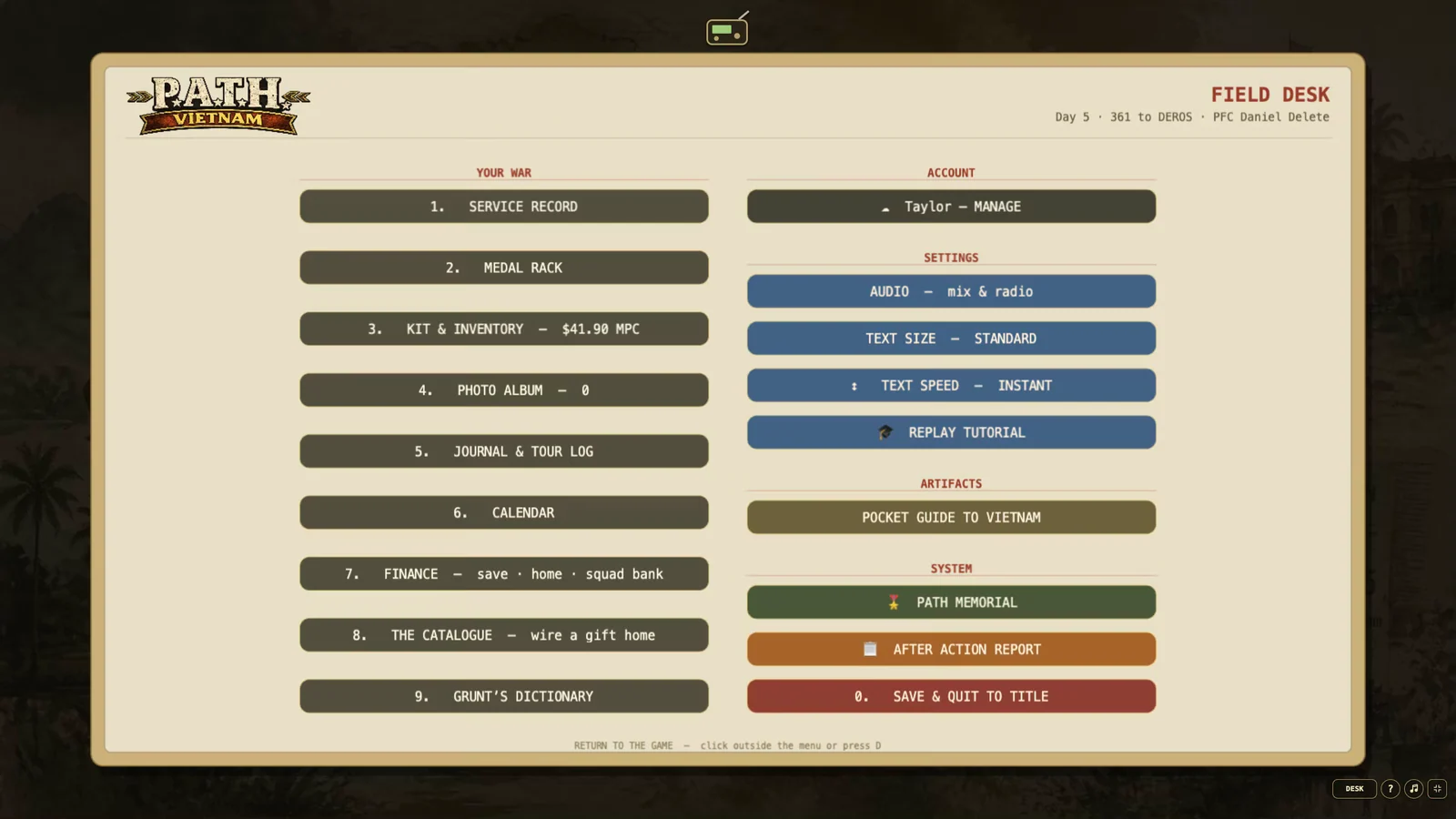
Press D, tap the desk control, and the day pauses.
The Field Desk opens on paper, records, kit, photographs, money, memory, settings, and a real artifact reader. It could have been a conventional pause menu. Instead, it became the place where P.A.T.H.: Vietnam's many parts admit that they belong to one life.
The Field Desk is not separate from play. It is where the player prepares, understands, remembers, and decides what the official flow of the day has not decided for him.
Your War
The left side of the desk is labelled “Your War.” That phrase is intentionally personal. The larger history continues around the character, but these tools show the part that belongs to his record.
The Service Record contains the Army-facing view: identity, attributes, skills, rank, specialty, training, active equipment bonuses, physical upkeep, carried load, and time remaining. It answers, “Who is this soldier now?”
The Medal Rack holds recognition after it has passed through the delay and formality of paperwork. It answers a more complicated question: “What did the institution decide to call this?”
Kit & Inventory divides possessions by where they are. An item in the footlocker is owned but not helping in the field. A carried item has immediate value and immediate weight. This screen turns preparation into a physical choice.
The Photo Album holds selected images. The Journal & Tour Log hold the automatic record and the player's own words. The Calendar shows the year as a shape, with DEROS waiting at the far end.
Together, these sections create a conversation between official record and private memory.
Money reaches in two directions
Finance and the Catalogue give the desk a life beyond the wire.
Finance tracks the money in the character's pocket, savings, support sent home, and informal loans within the squad. These are small systems with strong character implications. Saving says something. Spending says something. Helping a squadmate says something else, especially when repayment is not guaranteed to arrive on the schedule you prefer.
The Catalogue turns money into distance. The player can choose a correspondent and send a gift home. That gift does not teleport. Ordering, transit, receipt, and a possible reply belong to the calendar. The meaning is different from buying a comfort at the PX truck. One purchase changes today; the other reaches toward a life elsewhere.
The Field Desk places both choices side by side because the character has one pool of resources and more than one world making a claim on it.
Language, sound, and access
The Grunt's Dictionary helps the player understand period terms without forcing every scene to stop and define itself. It supports the setting while admitting that most players did not arrive already knowing the language.
The Audio section controls the overall mix, the environment, and the AFVN-style PATH radio. This separation matters. A player may want the atmosphere present but the radio lower, or may need the whole experience quieter. The radio itself now carries a set of original and remixed programmes—station voices, fictional DJs, announcements, service pieces, original songs, and date-aware shows—rather than leaning on a playlist of famous copyrighted recordings.
Accessibility & Sensitivity has become its own shared document. Text size and speed, Historical/Balanced/Redacted content treatment, motion, flashing, and decision pressure can be changed there. Decision pressure can keep the authored timer, extend it, or remove the countdown while preserving the choice and its consequence. Motion can follow the device preference or be reduced or removed. Flashes are separately controlled and default toward the safer presentation.
The same document can be reached from the desk and the persistent ! control. A new tour introduces these choices in the game's illustrated narrative style instead of dropping the player into a settings form. Access is not outside the game, and configuration should not become the first impression of it either.
The guided tutorial can also be replayed. That decision respects a simple truth: people forget interfaces. A player returning after a week should not be punished for needing the map again.
An artifact you can actually read
The Pocket Guide to Vietnam now sits under its own Artifacts heading. Opening it does not produce a prop or a single scanned cover. It opens a recreated 94-page 1966 guide with its front matter, illustrations, original page order, and searchable text.
I like what that does to the desk. The guide is part research object, part period voice, and part reminder that an issued manual has a point of view. A player can consult it without being told to accept every sentence as the final word on Vietnam. The game contains the artifact; it does not quietly promote the artifact to omniscient narrator.
That is a direction I want to continue. Objects should be worth opening. They should reveal their time, their usefulness, and their limitations instead of existing only as proof that an artist drew a convincing cover.
Account, memory, and reporting
When account services are configured, the desk provides access to sign-in and cloud-save management. Local autosave protects the immediate tour; an account is intended to carry it beyond one device.
A life-history game should not feel trapped in one browser session. At the same time, cloud features must earn trust through clear behaviour and careful handling. Source code can show that the pathway exists; only release-environment and hands-on testing can justify a promise that it works everywhere. The desk is where that relationship becomes visible to the player.
The After Action Report allows a player to report a problem with useful gameplay context. A good reporting path reduces frustration because the player does not need to reconstruct every detail of the moment by hand. The PATH Memorial, when available, gives remembrance its own place rather than turning it into a generic statistic.
These sections carry operational responsibilities behind the scenes, but the player-facing intention is simple: preserve the tour and make it possible to speak when something goes wrong.
A daily desk routine
You do not need to visit every section every day. A small routine is enough.
Before a demanding movement:
- Check Field Upkeep on the Service Record.
- Check carried load in Kit & Inventory.
- Check the Calendar if timing matters.
After an important day:
- Read the Journal & Tour Log.
- Add a private note if the automatic record missed the feeling.
- Look at new photographs or recognition when appropriate.
On a quiet day:
- Review Finance.
- Consider a letter, gift, or purchase.
- Train a skill if experience is banked and the character is at camp.
This rhythm turns the desk into a place of reflection rather than a wall of menus.
Why pause at all?
War games often value continuous motion. P.A.T.H.: Vietnam needs a meaningful pause.
The player is living hundreds of days. Without a place to stop, the details would blur into events and outcomes. The Field Desk allows the player to see what has accumulated: heavier kit, better training, fewer days, more photographs, a new rank, a debt, a letter, an entry that sounds different from the one written two months earlier.
The battlefield asks, “What do you do now?”
The Field Desk asks, “What has all of this done to you?”
Both questions belong to the game.