
The Catalogue Sends Something Home
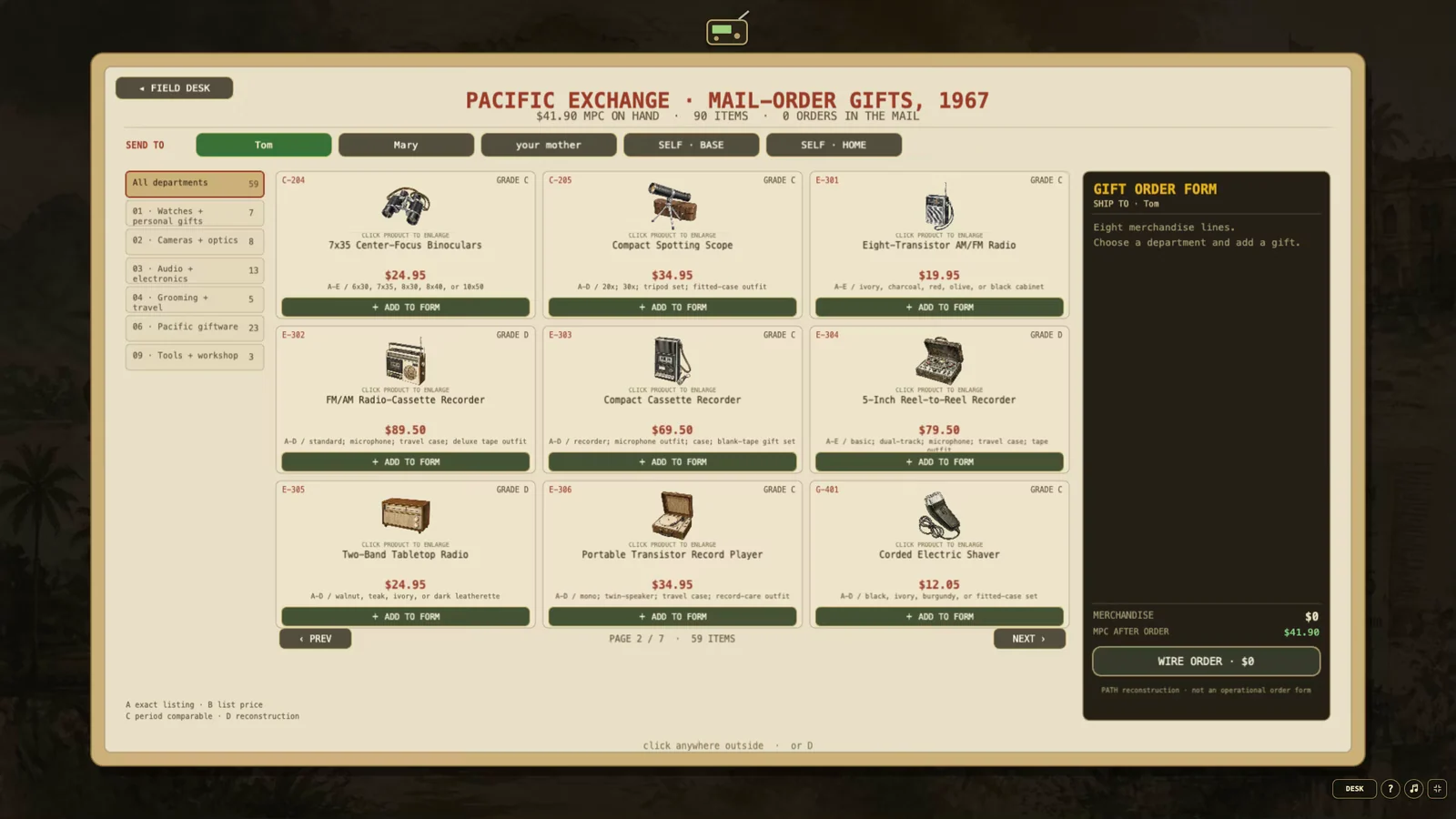
The PX sells things the soldier can use. The Catalogue offers something different: a way to make a choice in Vietnam that arrives in somebody else's life.
From the Field Desk, the player can select a correspondent, browse period departments, assemble an order, and wire a gift home. The available goods include watches, cameras, electronics, personal gifts, household items, tools, and toys. The screen can be enjoyed as a piece of 1967 material culture, but its purpose is not collecting.
The purpose is distance.
A gift begins with a person
Before browsing, choose the recipient.
That step changes the meaning of every item. A watch for a parent, a camera for a partner, a tool for someone who taught the character a trade, and a toy for a child are not four prices in different departments. They are four relationships.
LifeP.A.T.H. gives those relationships a foundation before the tour. The Catalogue lets the player act on them later. It can express affection, obligation, apology, pride, homesickness, or the desire to prove that the character is doing well enough to send something.
The game should not tell the player exactly what the gift means. That belongs to the character.
Try naming the intention before selecting the object. “I want them to know I remember.” “I want to send something useful.” “I need to make up for the last letter.” “I want home to have proof that I am still planning to return.”
Then browse.
The item belongs to its time
A mail-order catalogue is a compact portrait of aspiration. It shows what was presented as modern, desirable, respectable, fun, or practical in 1967.
Watches promise control over time. Cameras promise a record. Electronics promise connection and modernity. Household goods imagine a stable life far from the current one. Tools speak to work after the Army. Toys reach toward a child's world that continues without the sender.
P.A.T.H.: Vietnam uses historically grounded categories and pricing, but the player does not need a research lecture to feel the period. The objects do the work.
I also avoid presenting the catalogue as an exact reproduction of a private source. It is a researched game system, written and organized for play. The historical texture supports the relationship rather than replacing it.
Money makes the gesture real
A gift costs from the same financial life that supports PX purchases, saving, money sent home, and informal squad loans.
That shared constraint matters. If the Catalogue used a separate “gift currency,” generosity would be painless. Instead, the player gives up another possibility.
The sacrifice does not need to be severe. Even a modest order has meaning because it was chosen. A larger one may affect what the character can buy or carry later. A player who has committed to saving or supporting family must decide whether the gift belongs inside that commitment.
The Finance desk provides the larger picture. Check pocket money and existing plans before ordering. Then decide whether careful accounting is what this character would actually do.
Delivery belongs to the calendar
The gift does not arrive instantly.
It enters transit, and the calendar continues. Delivery takes time. A reply, if one comes, takes more. Seasonal pressure can make delays longer. The distance between order and response is part of the system.
This delay produces a special kind of anticipation. The player may forget the purchase during several ordinary days, then receive evidence that it crossed the distance. The gift has briefly lived outside the character's view.
That is more emotionally useful than an immediate “relationship +1” popup. The game can let the reply carry the consequence in human language.
Delay also means timing matters. A late-tour order may be racing the soldier home. A holiday gift must compete with slower mail. An impulsive purchase may feel different by the time the answer returns.
The Catalogue as a character test
Consider three characters with the same pay.
The first chooses a practical appliance for home. He imagines himself as responsible and useful even from far away.
The second sends a camera. Perhaps he wants the person at home to create a record he is missing, or perhaps he wants photographs sent back.
The third sends nothing. He saves carefully, spends on the squad, or cannot find an object that makes the distance feel honest.
None is automatically better. The Catalogue reveals how the player understands the character's relationship with home.
The decision can change over the tour. A person who ordered expensive gifts early may become quieter. Someone who avoided the catalogue may finally use it after an important letter. One gift can mark a turning point without the game announcing that a turning point has occurred.
A simple way to use the feature
If a large catalogue feels overwhelming, use this method:
- Choose the correspondent first.
- Decide whether the gift should be useful, personal, playful, or symbolic.
- Set a price you are willing to spend.
- Select one object that fits all three.
- Write a private journal line about why, if the game moment invites it.
This keeps the feature about intention rather than completion.
You are not expected to buy one item from every department. There is no reward for emptying the catalogue. The year is not a shopping checklist.
Sending part of the character home
The most interesting mail-order object is not necessarily the rarest or most expensive. It is the one that carries a piece of the sender.
A watch can say, “I am counting.” A tool can say, “I remember what you taught me.” A toy can say, “I know your life is still happening.” A camera can say, “Keep something for me.”
The Catalogue gives the player a screen full of goods. The game itself begins when one of those goods becomes a message.