
The Radio Brings the World Together
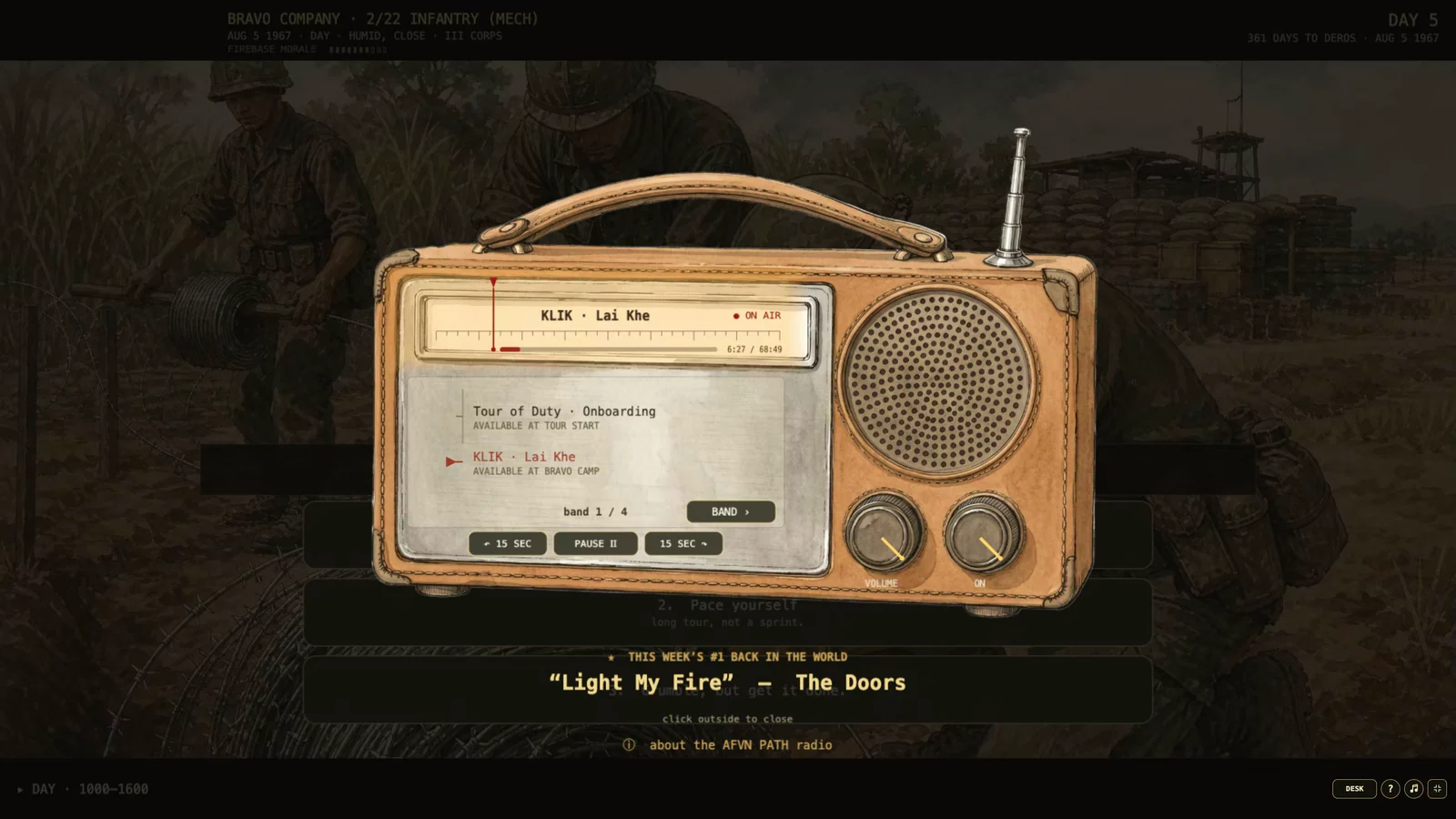
A radio can fill a small space with a world the player cannot see.
That was always the reason to have one in P.A.T.H.: Vietnam. The player spends so much time close to one soldier—his desk, squad, kit, duties, memories, and count toward home—that sound becomes the easiest way to open the horizon.
The radio was also one of the parts of the game that had to be reconsidered most seriously. The first idea was obvious: find old Armed Forces radio, use the period broadcasts, and let 1967 speak for itself. The obvious idea was not the honest or practical one.
What exists now is much more interesting. I have been building a fictional radio world from original music, invented performers, fictional station voices and DJs, recreated programme formats, remixed announcements, public-service pieces, news-style material, station IDs, and all the awkward little joins that make a broadcast feel alive.
It is not a famous-songs playlist. It is the sound of a year being rebuilt for the game.
The copyright problem changed the creative direction
An old government broadcast may be preserved in an archive, and parts of that recording may have a public-domain basis. That does not automatically make the commercial records played during the broadcast free to copy into a game. The announcer, government-produced segment, station recording, song composition, and recorded performance can all carry different rights questions.
That distinction matters no matter where P.A.T.H.: Vietnam is eventually released. A web game, an itch.io build, a Steam release, and an app still have to respect the work heard inside them. Changing the storefront does not change copyright.
I could have treated this only as a restriction: remove the recognizable songs, leave holes, and apologize for what is missing. Instead, it became a design opening. If the game could not borrow the complete sound of an old broadcast, it could create a radio culture of its own.
That approach reduces dependence on copyrighted commercial recordings, but it does not turn the final rights review into a formality. Every finished programme, voice, composition, performance, source element, and agreement still needs a release-specific check. “Original” is a creative description, not a substitute for keeping good records.
Fictional does not mean careless
The goal is not to fool anyone into believing a newly made programme is an untouched archival recording. These are PATH remixes: a simulated AFVN-era sound built for this game.
That means the invented DJs need personalities without becoming cartoons. The announcements need the clipped confidence, repetition, and institutional tone of radio made for service members without pretending to quote a broadcast that was never recorded. Public-service spots can be earnest, strange, useful, and occasionally unintentionally funny, as real station life often is.
The music needs variety too. A believable station does not play sixty minutes of songs about Vietnam. People heard love songs, dance records, instrumentals, novelty numbers, late-night pieces, homesick songs, confident songs, and music that had nothing to do with the place where the listener happened to be.
That is why the fictional catalogue includes bands and performers with their own names rather than anonymous “period music.” The Switchboard Saints can be credited for “Ruby.” The Breakwater Runners have “Breakwater Run.” The Unmeasured Hours have “The Visitor.” A Listener Top 20 can feel like a real chart because the songs belong to a small imagined music scene, not because I quietly substituted soundalikes for famous artists.
The line I am trying to hold is simple: evoke the era, do not counterfeit it.
A dial that grows with the tour
The current game contains seven radio programmes delivered through twelve local audio parts. The split files behave as complete programmes on the dial, so a listener does not need to know where one technical part ends and another begins.
The selection includes the Tour of Duty opening mix, KLIK from Lai Khe, Command Information, Town and Country, Dawn Buster from Saigon, a late-night album special, and Listener Top 20 · Saigon.
They do not all appear at once. The radio opens with the induction. KLIK becomes part of the player's world after reaching Bravo Company. Later programmes unlock with the campaign date. That turns the dial into another kind of calendar: the sound available in August is not exactly the sound available in late October.
This is a small decision with a large effect. A programme can become associated with arrival, a particular week, a person in the hooch, or a period when the tour still felt new. When a new show appears, it marks time without putting a banner across the screen.
The small pieces sell the world
The songs matter, but the connective tissue often does more work.
A station ID tells the player where the signal imagines itself to be. A DJ talking over the end of a record gives the next item momentum. A chart rundown suggests other listeners and their requests. A weather line can be ordinary information on one day and bitter comedy on another. A PSA can reveal what the institution is worried about. A remixed announcement can place the player inside a larger machine without opening a history lecture.
Those pieces also make room for tone. The radio can be energetic while the character is exhausted. It can sound reassuring when the day was not. It can make Dầu Tiếng feel less isolated and, in the next minute, make home feel farther away.
That tension is more valuable than a permanent morale bonus. Radio can be comfort, noise, memory, company, irritation, or the thing nobody turns off even though nobody seems to be listening.
The player still controls the room
The Field Desk keeps radio volume separate from the master and environmental mix. The radio can be lowered or switched off. Programmes can be selected when they are available, and split recordings continue along one timeline instead of behaving like disconnected tracks.
Those controls matter creatively and practically. Some players will want the radio to sit behind the camp atmosphere. Some will put it at the centre of a quiet shift. Some will read better without voices in the room. Silence is not missing content. It is one of the ways a player can shape the experience.
The RTO may hear the radio differently from everyone else. His working day is already filled with procedure, batteries, clarity, and urgent messages. The station set offers voices that ask nothing directly of him. A Mechanic may associate a programme with work. A Medic may want sound after a difficult day or find that he cannot tolerate it. The system supplies the broadcast; the player supplies the association.
What has changed
The earlier dispatch about this feature described interfaces, experiments, and a future rights problem. That was accurate when it was written, but it is no longer the whole story.
The radio has become a substantial authored part of the game. Original songs exist. Fictional artists have credits. DJs and station voices carry programmes. Announcements and service pieces create the spaces between songs. Shows unlock with the tour and continue across their audio parts. The player can tune the mix rather than accept one imposed soundscape.
There is still work to do: listening passes, level matching, source and rights records, performance checks, and testing in whatever release package is chosen. The current source proves that the radio is implemented. It does not, by itself, declare every file legally or editorially approved for every future release.
That is not a disappointing ending. It is the useful truth.
The radio is no longer waiting for a collection of famous songs to make it feel complete. It has started to develop its own memory, its own performers, and its own strange corner of 1967.
One radio still calls for support outside the wire. The other brings the wider world into the hooch.
Both make the world larger. Only one has a Top 20.