
History Without the Lecture
P.A.T.H.: Vietnam is built around a real unit, place, and calendar. That gives the game historical weight. It also creates a design problem.
How do you help the player understand the year without turning every morning into a lecture? How do you use the record without pretending that a game can reproduce the past? How do you portray danger and consequence without making suffering into spectacle?
There is no single solution. The project uses several smaller ones.
Put history in the day
Historical context appears through events filtered by date and unit. News, rumour, operations, political change, weather, and the effects of the wider war can reach the player as part of the ordinary rhythm.
This matters because history did not arrive for people as a completed chapter. It arrived as incomplete information.
A radio bulletin may be calm while the squad's experience is not. A rumour may be wrong. A national event may affect people differently inside the same hooch. The player can know more than the character because the story is approached with hindsight, but the scene should still respect what was knowable then.
The game does include major set pieces connected to the unit's tour. They anchor the year. They should not make the days between them feel disposable.
Let objects carry context
History also lives in kit, prices, magazines, radios, forms, photographs, vehicles, and language.
A dated magazine issue on the PX reading rack can show what the outside world was discussing. A Service Record shows how the institution viewed a person. A mail-order catalogue reveals what people wanted and imagined for home and the field.
These details are effective because the player uses them. The item is not an exhibit behind glass. It competes for money, space, attention, or meaning.
Material culture can teach quietly, but accuracy still matters. A product, price, issue date, weapon, unit label, or place name should not be treated as “close enough” simply because it looks right.

A whole book, not a decorative prop
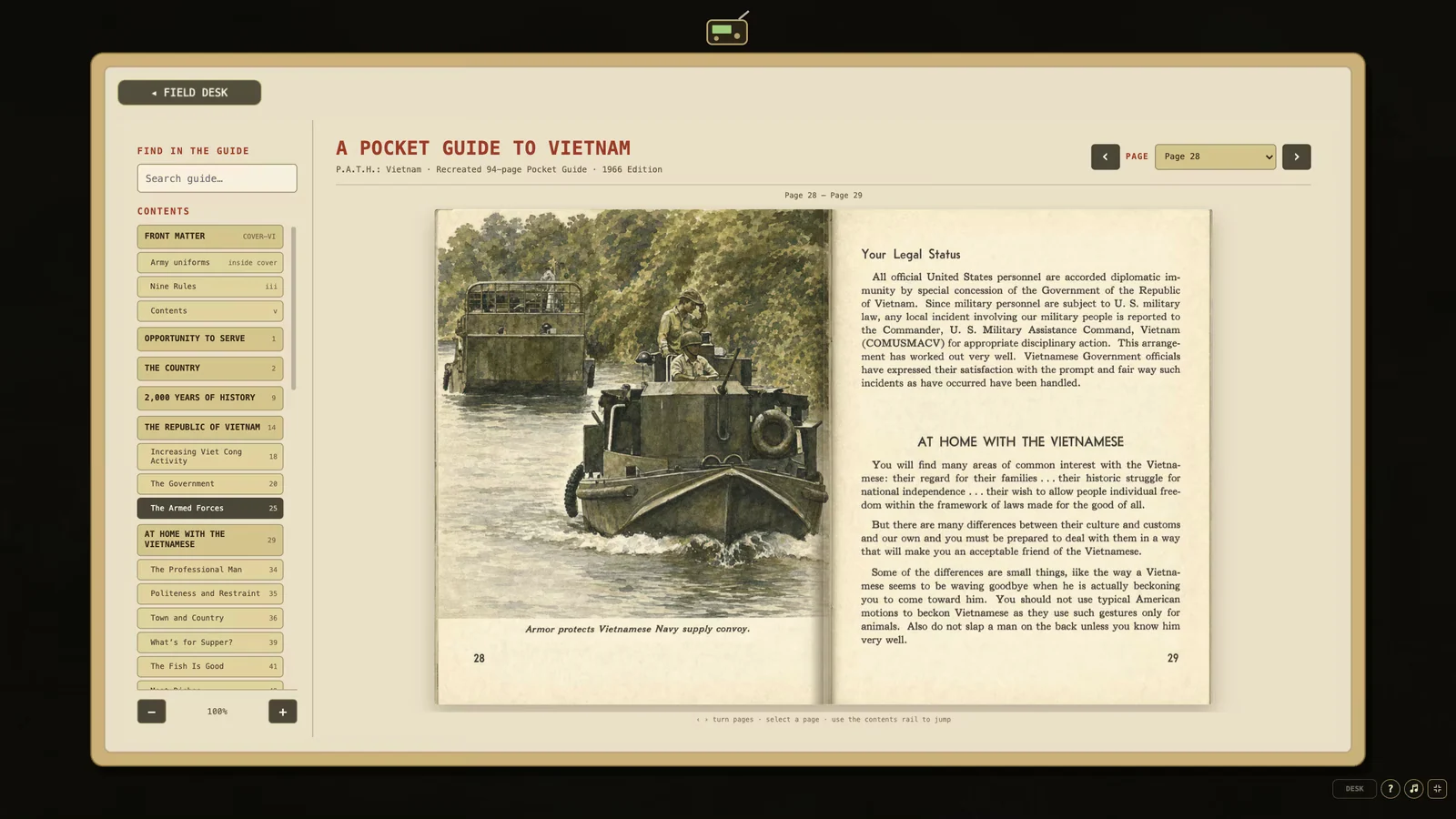
The recreated Pocket Guide to Vietnam is a good example of the extend I went to to recreate in-game artifacts. It is not just a single cover image placed on a desk to suggest research happened. The in game book reader contains a complete recreated 1966 edition of the guide: 94 pages, cover to cover, now with coloured illustrations, full content with searchable text.
That completeness creates a more interesting kind of historical encounter. The guide can be useful, dated, revealing, limited, patronizing, observant, or contradictory—sometimes on the same page. It shows what an institution chose to tell an American service member at the time. It does not become the game's neutral narrator just because it is an official-looking object.
Recreating the artifact also creates responsibilities. The game reader must clearly present it as a period document. Its assertions still need historical context; implementation does not prove them true. Searchability should help a curious player find a place, phrase, or subject without pretending that one pocket guide contains Vietnam. The object is evidence of a point of view, and its limits are part of what makes it worth examining.
To view the pocket guide, simply open the Field Desk (D) Menu and open "Pocket Guide to Vietnam" under ARTIFACTS.
Separate evidence from confidence
The project draws from records, manuals, research, and historical sources. Those sources do not all support claims with the same strength.
A unit date may be well established. An exact everyday practice may be common but unevenly documented. A radio detail may come from an archival recording whose rights status is separate from its historical value. A story repeated in later memory may be meaningful without being precise enough to script as a universal fact.
Good historical design keeps these levels separate behind the scenes.
The player does not need an academic footnote in every dialogue box. The project does need a provenance process strong enough to know when a claim is confirmed, reconstructed, uncertain, or simply planned for later review.
Honesty at the source allows lightness on the screen.
A character is not a documentary camera
The player's tour is historical fiction. The unit, dates, places, and many events come from the record. The player character and his personal sequence are created for the game.
This distinction protects both history and roleplaying.
The game should not insert a fictional character into a real person's death and imply ownership of that story. It should not present a generated image as an archival photograph. It should not let one campaign outcome claim to be what “really happened.”
At the same time, fiction can help a player understand scale and consequence that a list of facts cannot. The responsibility is to mark the boundary and avoid borrowing authority the game has not earned.
Content settings are not a truth switch
P.A.T.H.: Vietnam supports different content approaches, including Historical, Balanced, and Redacted presentation.
These settings allow players to choose how directly difficult material is described. They do not create three different histories. A less explicit presentation should preserve the fact and consequence without forcing every player through the same level of detail.
This is especially important because context, comfort, and audience vary from one player and setting to another. Accessibility includes emotional access as well as text and sound.
The most graphic version is not automatically the most honest. Restraint can be more respectful than detail.
Make room for Vietnamese lives
A game following an American soldier will naturally limit the player's point of view. It must not mistake that point of view for the whole country.
Vietnamese civilians, South Vietnamese forces, local communities, and the people identified as enemies all had lives beyond the American unit's understanding. The game cannot fully represent every perspective through one tour. It can avoid reducing everyone outside the squad to scenery or targets.
Trust, language, medical interaction, local consequence, and careful context are part of that effort. So is admitting uncertainty.
Historical respect is not achieved by adding one explanatory speech. It is a standard applied across writing, art, systems, and what the game chooses not to make collectible.
Learning through curiosity
The best outcome is not that the player finishes the tour believing the game told him everything.
It is that a date, unit, place, object, or voice creates curiosity. The player may visit a memorial, read further, listen to veterans and Vietnamese voices, or return to a historical question with greater humility.
The game can provide credits and source guidance. The blog can discuss research in original language without exposing private manuals or copying protected material. The design can show where evidence shaped a correction.
None of that turns P.A.T.H.: Vietnam into a textbook.
The quiet test
For each historical element, I ask:
Does this help the player understand the day? Is it supported? Is it placed in the right time and context? Does it respect the people involved? Does the game know the difference between fact and fiction? Can the player approach it at an appropriate level of detail?
If the answer is yes, the history can enter without stopping the tour.
The goal is not a lecture. It is a year that feels accountable to the world and time in which it is set.