
The Fixes a Player Can Feel
Development progress is often reported through things a player cannot feel: files changed, systems reorganized, checks passed, or a list of internal tasks. Those details matter while I am building the game. They are not the experience.
For P.A.T.H.: Vietnam, the better question is: what has become clearer, smoother, more trustworthy, or more meaningful on the player side?
Several of the project's strongest improvements began with something that did not work well enough.
The calendar became literal
The tour runs from 1 August 1967 to 1 August 1968. That span crosses 29 February 1968.
An earlier “365-day” assumption fit the familiar language of a one-year tour but not the actual dates. The current calendar keeps all 366 played days and places the final wake-up after them.
What the player feels is simple: the dates remain honest. Historical events, mail, pay, seasons, DEROS, and the day count do not need to bend around a missing leap day.
The lesson is larger than one number. If time is a central character, time deserves exact treatment.
The tutorial began opening the real game
A tutorial can explain a menu beautifully and still fail when the player opens the actual menu later.
P.A.T.H.: Vietnam now uses a guided walk through the real Field Desk, Service Record, Kit, Journal, Calendar, and Radio. The player learns each tool in place. The walk can be skipped and replayed.
What the player feels is continuity. The screen used for teaching is the screen used for the tour. Returning players can refresh themselves without restarting the campaign.
The setback was not a dramatic failure. It was the recognition that explanation alone is weaker than guided use.
The opening stopped looking like setup
A later correction happened even earlier in the experience. A new tour needs to explain mature content, motion, flashing, timed decisions, and the controls available to the player. The first attempt made that responsible information too much like an administrative screen.
The current opening begins on an illustrated history plate in the game's own narrative language. The player can continue with the existing preferences or choose to adjust settings. The same safety document remains available through the persistent ! control and the Field Desk.
What the player feels is an introduction to a game, not a form that must be completed before the game agrees to begin.
The menus learned to fit different screens
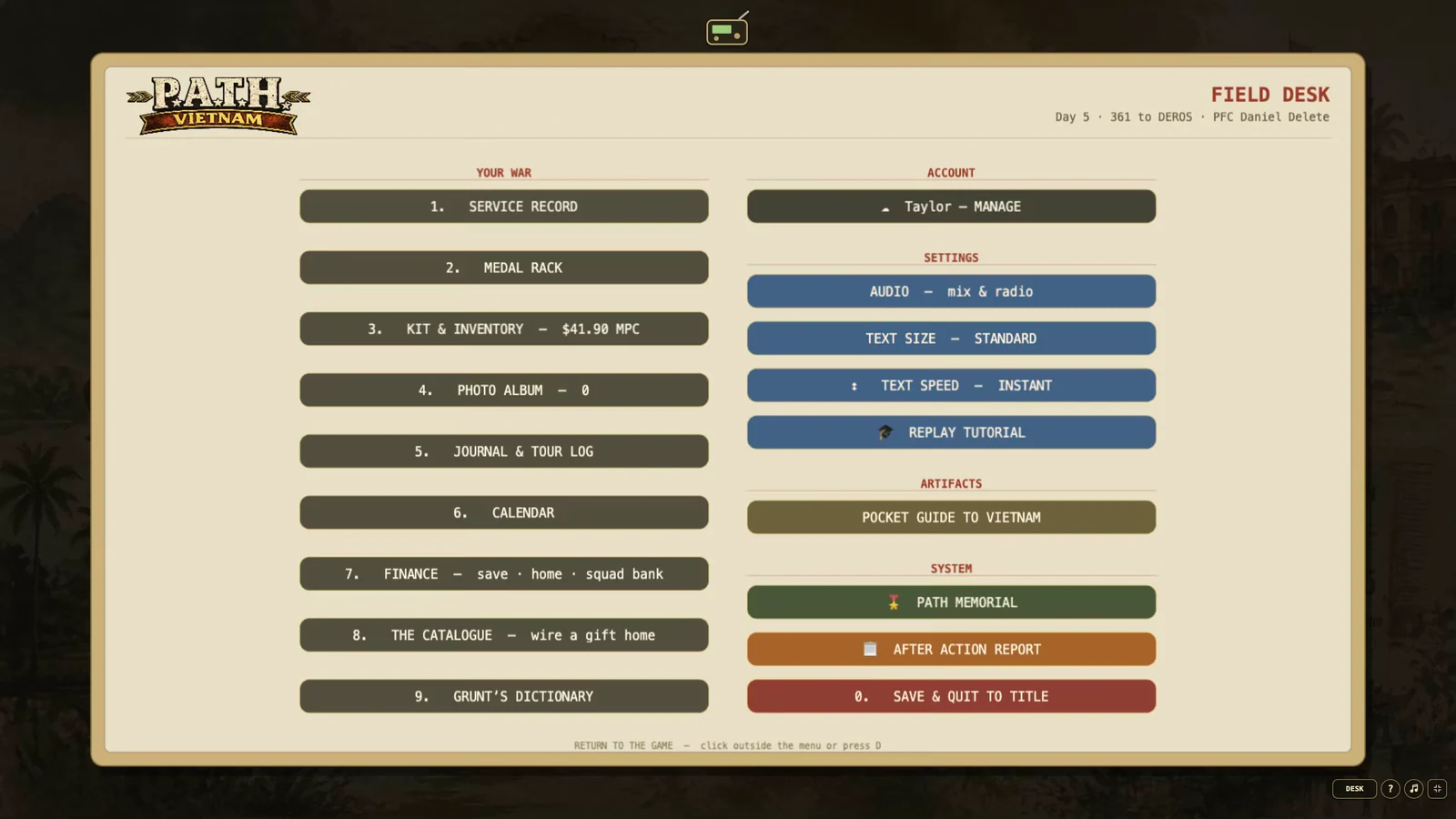
The Field Desk grew because the soldier's life grew: medals, kit, photos, journal, calendar, finance, catalogue, dictionary, audio, accessibility, account, reporting, remembrance, and a complete Pocket Guide artifact.
At one point, growth made the bottom of the menu vulnerable on shorter screens. The Grunt's Dictionary could effectively disappear below the usable area.
The desk now measures the available space and adjusts rows and spacing so the whole set remains reachable. Visible controls support touch, mouse, and keyboard without making any one of them the secret “correct” way to play.
What the player feels is not “responsive layout logic.” The player simply sees the button and can tap it.
This is a useful definition of polish: the absence of a frustration that would otherwise break trust.
The systems stopped shouting
Stress, morale, trust, skill checks, and consequences all need to be legible. Putting every value on screen would make them legible and turn the tour into a control panel.
The project has moved toward showing these systems through fiction, plain condition language, the Service Record, and the journal. The dice engine can remain real without requiring the player to perform every calculation.
What the player feels is consequence without constant interruption.
The design has not hidden everything. A player can inspect condition, training, load, and records. The improvement is that the information now has a place instead of competing with every scene.
Equipment acquired a location
An inventory that treats every owned item as instantly available creates easy collection and weak preparation.
Kit & Inventory now distinguishes carried equipment from the footlocker and the rucksack layer. Useful gear helps only when it is on hand. Weight affects Mobility and Stamina. Dropping the ruck changes the active load.
What the player feels is the difference between owning, packing, and using.
This makes several archetypes more distinct. The RTO's radio, Medic's supplies, Machine Gunner's ammunition, and Engineer's tools create different physical problems. The same system also gives personal objects a cost worth accepting.
Recognition learned to wait
Immediate rewards are clear, but they can flatten the event that produced them.
Medals and promotions now belong to paperwork, delay, and later ceremony. The official recognition arrives after the player has had time to read the journal and live several more days.
What the player feels is the distance between experience and citation.
The rack remains satisfying. It simply stops pretending that recognition was the first meaning of the moment.
Saving began respecting more than one device
A long tour needs persistence. Local autosave protects ordinary play. Account and cloud work aim to let the same signed-in player find the tour across devices without one session carelessly replacing another.
What the player should feel is confidence: close the game, return later, and continue the right life.
This area still needs release-environment and cross-device validation before I can promise it without qualification. Source code and automated checks are evidence of implementation, not proof of every production path.
That distinction is part of quality too.
What is working now
The current working build has a coherent player spine:
- A LifeP.A.T.H. character journey and eight-role launch roster
- Arrival and a guided introduction to the real tools
- A four-shift daily loop
- Kit location, weight, upkeep, and role-specific capability
- Journal, bounded recent Tour Log, photos, calendar, finance, catalogue, and
medals
- A recreated 94-page Pocket Guide to Vietnam inside the Field Desk
- Seven date-aware radio programmes built from original and remixed PATH audio
- Persistent text, content, motion, flashing, and decision-pressure controls
- Touch, mouse, and keyboard input
- Local saving, with account and cross-device systems implemented for
configured environments
The project also has a substantial automated test suite around rules, persistence, content, dates, menus, equipment, and other systems. The final release claim must still be based on a current green build and hands-on device testing.
Progress without pretending
None of these wins means the game is finished.
The original/remixed radio strategy removes the need to build the experience around copyrighted hit recordings, but finished audio still needs a release-specific rights and listening review. Production services require verification. Suspend and resume, offline behaviour, performance, input, account flows, and the complete tour need testing in whichever release packages are seriously considered.
The useful story is not “everything works.” It is that each correction has moved the project toward a more coherent player experience.
A missing day returned to the calendar. A hidden menu item became reachable. A tutorial became real use. A settings form became an illustrated welcome. A backpack became more than a number. A pocket guide became a book the player can actually open.
Those are the fixes a player can feel.