
Rebuilding a Pocket Guide, Page by Page
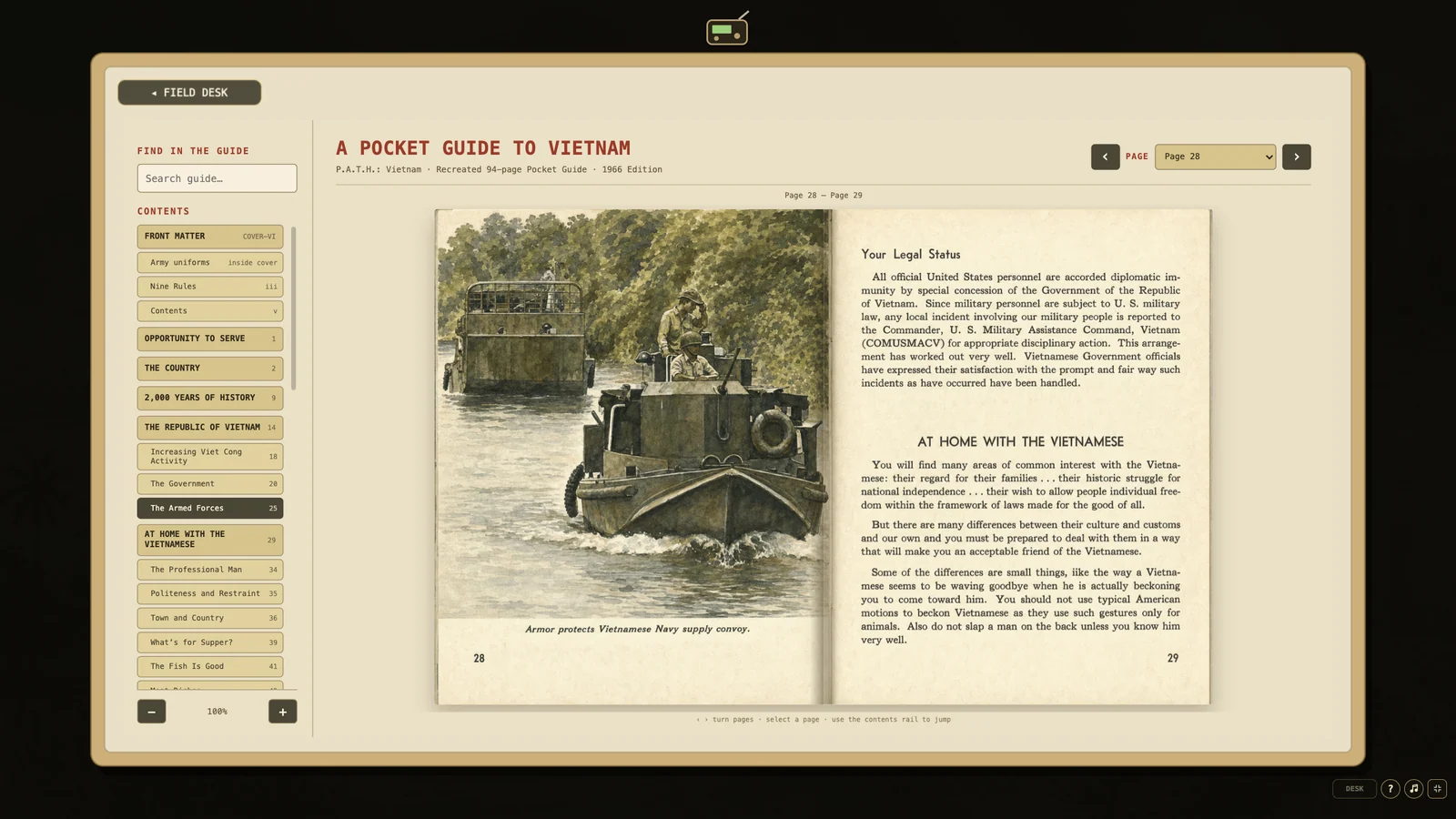
I found an original copy of A Pocket Guide to Vietnam and immediately wanted to spend time with it.
It is a small U.S. government publication from the period, created to introduce American service members to the country where they were being sent. Because it is a government publication, the source is in the public domain. More importantly for the game, it is the kind of object a soldier could actually have held.
The obvious approach would have been to show the cover, write a short summary and move on. I chose the less sensible and much more satisfying approach: I recreated the complete guide for the Field Desk.
That changed it from a historical reference into an in-game artifact.
Why the whole object matters
A cover tells the player that a publication existed. Pages show what the publication was trying to do.
The guide moves through history, government, food, customs, religion, places, language, pronunciation, practical phrases and official advice. It carries the voice of an institution preparing people for an overseas assignment. That voice can be informative, awkward, paternal, revealing and incomplete—often on the same page.
Reducing the publication to a few selected quotations would make it easier to consume, but it would also allow the game to quietly choose the “good parts” and hide the shape of the original. Preserving the sequence lets a player see how the publication framed Vietnam, what it emphasized and what it left out.
The current recreation includes the 94 numbered pages along with covers and front matter, presented as 104 readable surfaces. The player can move through spreads, use the contents, select a printed page, search the text and adjust the zoom.
It is still a book, but it does not punish the player for using a screen.
Recreating is not the same as endorsing
Public domain means the source can be reproduced. It does not mean every claim inside it becomes neutral or timeless.
The guide represents a particular American government perspective at a particular moment. It is not the complete history of Vietnam. It is not a substitute for Vietnamese voices, later scholarship or the evidence of people who lived through the war. Some language belongs plainly to its era and institution.
That limitation is part of why the artifact is useful. The player is not only learning what the booklet says. The player is also encountering what an American service member was told before or during the tour.
P.A.T.H.: Vietnam can place that institutional explanation beside daily events, letters, field experience and other historical material. Agreement is not required. The friction between the official guide and the lived campaign is a layer of engagement that a modern summary would erase.
Making a document feel present
The first version proved that the pages could be opened. That was not enough.
A historical artifact should feel handled. The Field Desk reader therefore keeps the covers, page proportions and two-page rhythm. Forward and backward controls move one spread at a time. Keyboard arrows work. Contents links and search results land on the requested printed page instead of somewhere near it.
The page-turn animation became its own small design problem. With full motion, the outgoing page folds and the new spread settles into place. With reduced or no motion, the page changes immediately. Repeated taps are locked during the turn so the book does not skip unpredictably, and a fallback completes the change if a browser misses the animation signal.
This is a good example of an effect serving the object instead of advertising itself. The page turn adds physical character when the player wants motion. It gets out of the way when the player does not.
An earlier guided-tour layout also allowed the book to cover its own instructional caption. The fix was not another patch of text on top. The reader was given a reserved caption band during the tour, while normal Field Desk use kept the full-height book. The artifact and the explanation could finally share the screen without fighting.
Different players can use it differently
The Pocket Guide does not have one correct reading path.
A player can browse it before beginning the tour. Someone interested in language can jump directly to pronunciation, tones or common phrases. Another player may search for a place after it appears in the campaign. Someone else may simply turn a few pages and return later.
That flexibility is the extra layer I wanted. The guide is not a mandatory lecture inserted before play. It is a resource inside the soldier's world.
It can also create small moments of recognition. A phrase seen in the book may appear differently in practice. A piece of official advice may sound more complicated after a field encounter. A description of the country may sit uneasily beside the date currently marked on the calendar.
Those connections are not scored. The artifact becomes valuable when the player makes them.
The pleasure of taking an object seriously
Recreating the guide was far more work than using a cover image. It also became one of the clearest statements of what P.A.T.H.: Vietnam is trying to do.
The project is interested in the whole texture of a tour: what was carried, read, heard, bought, filed and remembered. A government booklet can be part of that texture without becoming the game's final word on history.
The original copy gave me the spark. The digital version adds search, readable navigation, motion choices and a place inside the Field Desk. The result is not just a scan and not quite a modern book.
It is an old artifact given a new use: something the player can open, question and return to as the tour changes around it.