
Field Briefing or Full Induction? A Better Way Into the Tour
Beginning a new game should feel like the start of a unique experience.
That sentence sounds obvious. It took several passes to make it kinda of true for P.A.T.H.: Vietnam.
The project has a great deal to introduce: mature subject matter, sensory controls, the historical setting, the soldier's route into service, LifeP.A.T.H. choices, training, role selection and the practical tools used during the tour. Putting all of it in front of the player at once created an accurate but exhausting first impression.
The current opening now makes one early promise: the player can choose the length of the road in without choosing a lesser character.
That is the purpose of Field Briefing and Full Induction.
The game introduces itself in its own visual language
An earlier version opened a new tour with a dense settings document. The controls were important, but the experience felt administrative. The first thing the player saw was configuration rather than story.
Placing an illustration behind the document did not solve the problem. A panel covering a painting is still a panel.
The revised sequence begins on the illustrated Southeast Asia history plate. The first caption explains that P.A.T.H.: Vietnam is a long-form illustrated role-playing game about one soldier's 366-day tour. It notes that the game contains mature wartime events and may use movement, flashing effects and time-limited decisions.
From there, the player can adjust the experience settings or continue with the current preferences. Settings are available, visible and informed, but they do not pretend to be the opening scene.
Only then does the game ask how much induction the player wants.
Field Briefing is shorter, not hollow
Field Briefing compresses the historical and training introduction. It gives the player the essential road to 1967, the war as it reached the living room, the choice between being drafted or enlisting and a shorter illustrated training route.
It does not remove the decisions that create the soldier. Background, identity, role and the other LifeP.A.T.H. choices remain. The player still receives a complete Service Record and begins the same 366-day campaign.
This route is useful for a returning player, someone eager to reach character creation or a player who understands the context and does not want every historical beat repeated.
“Short” should never mean “the game silently made important choices for you.” That was the rule behind the design.
Full Induction lets the road have weight
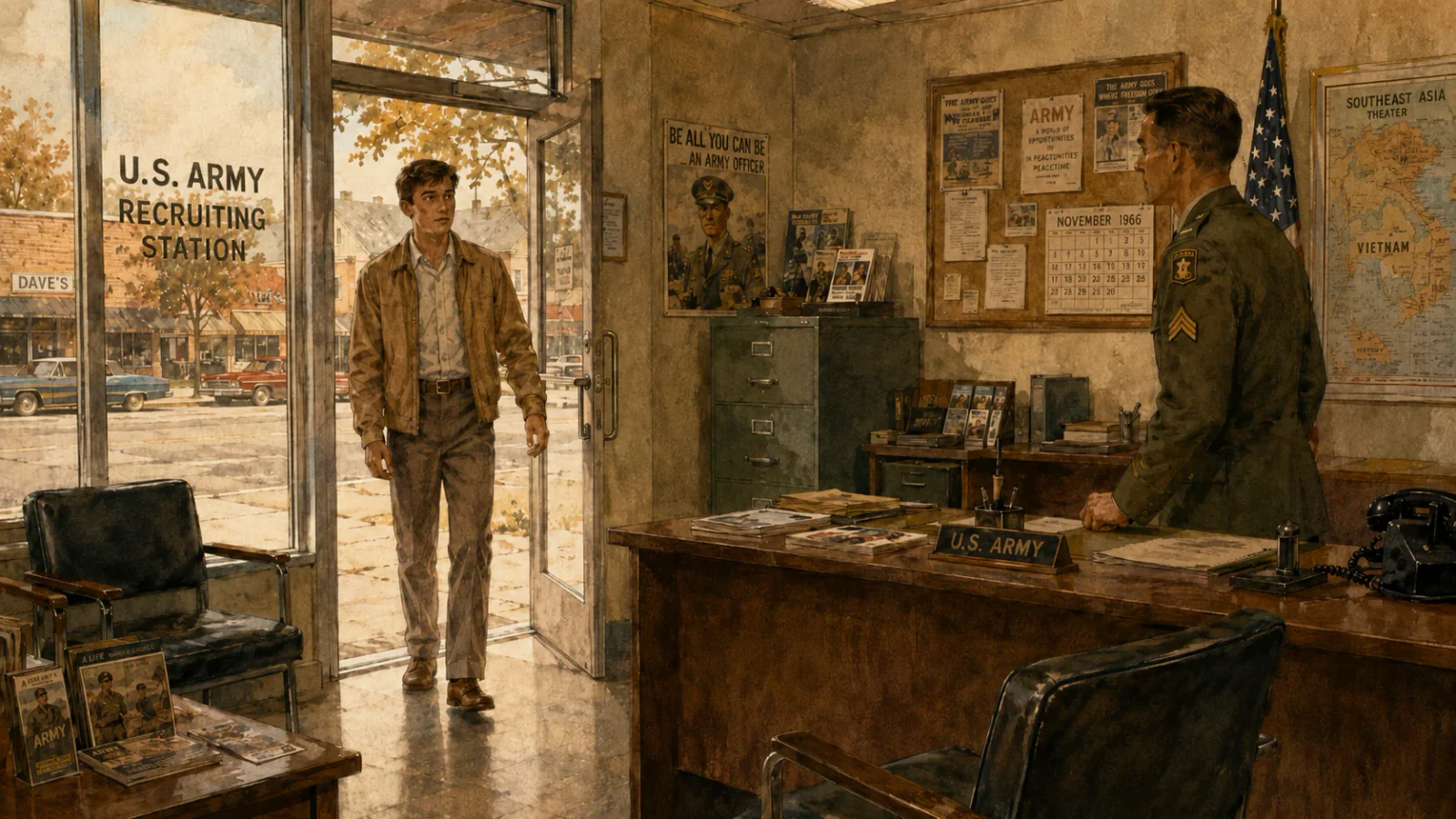
Full Induction preserves the longer historical and personal prologue. It spends more time on the history before the soldier, the war on television, the letter or recruiting office, home, reception, basic training, Tigerland and the route toward deployment.
This version is not a tutorial in the usual sense. It is part of the character story. The player is not merely learning which button opens Kit. The player is seeing how a person moves from ordinary life into an institution, then from training into a role and finally toward Vietnam.
For a first tour, Full Induction provides the richest context. It gives later objects—the letter, hometown, uniform, Service Record and departure—something to echo.
It also gives the player time to understand the tone. P.A.T.H.: Vietnam is not going to hurry from a title screen to a firefight. The long route says that plainly before the calendar begins.
The handoffs matter as much as the writing
Onboarding problems are often visible between scenes rather than inside them.
At one point, the final training image disappeared before the Service Record art and character portraits were ready. On a cold load, the player could see a black gap. The story had not failed, but its confidence had.
The current transition keeps the training plate visible while the next visual elements are prepared. The history artwork is also warmed while the title is open, so the first illustrated frame does not begin by waiting for itself.
These are small changes in engineering terms and large changes in feeling. A good induction should feel deliberate. A flash of empty canvas tells the player that the machinery is struggling backstage.
The same care applies to pacing. Each frame advances by tap, click, Space or Enter. The player is invited forward rather than trapped behind automatic timers.
Onboarding and the guided tour are different jobs
The induction explains how the soldier reached the tour. The guided tour shows where the game's tools live.
After character creation, the guided layer can open the real Field Desk, Service Record, Kit, Finance, catalogue, Journal, Calendar, Pocket Guide and Radio. It can be skipped by someone who knows the system and replayed later from Help.
Keeping those jobs separate reduces the temptation to explain every menu while the player is still trying to understand the person being created.
The result is a cleaner learning curve:
- Meet the experience and choose presentation settings if needed.
- Choose Field Briefing or Full Induction.
- Create the complete soldier.
- Learn the practical Field Desk through a skippable guided tour.
- Begin the dated campaign.
Two routes, one promise
The important part of the new choice is what it does not change.
Field Briefing does not create a simplified soldier. Full Induction does not grant an advantage. Neither route changes story consequences or produces a different campaign. The choice is about context and pace.
That makes it an honest onboarding choice. The player can decide how much road to walk before 1 August 1967 without worrying that the “wrong” selection will damage the next 366 days.
The game still has a lot to teach, but it no longer needs to teach everything before it has introduced itself. It opens with an image, asks how the player wants to proceed and then respects the answer.