
A Day in Four Shifts
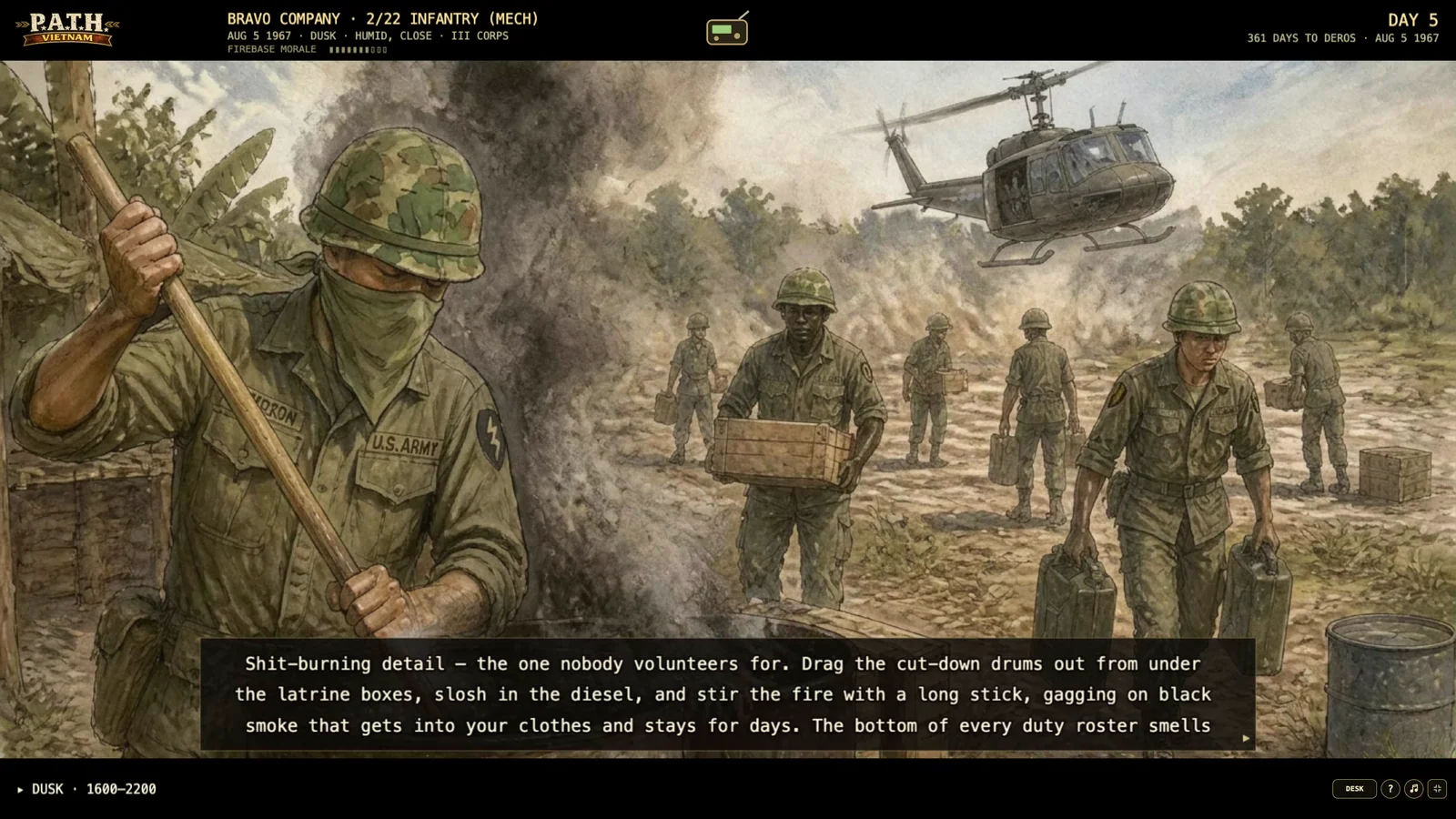
Every day in P.A.T.H.: Vietnam has four parts: Dawn, Day, Dusk, and Night.
That division looks simple on the Action Board. Its purpose is larger than organizing buttons. Four shifts let the game show how the meaning of a day changes as light, work, information, fatigue, and anticipation move through it.
A letter received at dawn is not the same object by dusk. A rumour heard in the morning can shrink, grow, or become irrelevant. A neglected task can follow the character into the night. A quiet day can still feel different in each piece.
Learning the four-shift rhythm is the quickest way to feel at home in the game.
Dawn: the day arrives before the plan
Dawn is a moment of attention. The base wakes, the perimeter matters, and the day's first event establishes what is in the air.
That event may be news, mail, weather, a rumour, a moral problem, a practical need, or the larger war reaching the unit. It is not always an assignment. Sometimes it simply changes how the player reads what follows.
At dawn, check the soldier before committing the day. Has he eaten and slept? Are his feet becoming a problem? Is the weapon maintained? Is there an operation or duty that makes the current loadout inappropriate?
You do not need to open every menu every morning. The point is to notice when the day asks for preparation.
Dawn also carries the emotional count. The calendar has moved. DEROS is one day closer, but the distance may still feel enormous. Early in the tour, the number is abstract. Later, each decrease has a different sound.
Day: the substantial work
The Day shift often holds the major action: the work detail, watch, recovery, movement, or operation that defines the practical centre of the day.
Major actions consume more than time. They affect the body, the base, the squad, and the character's experience. Pulling a detail can improve the place everyone depends on. Rest can be the disciplined answer when fatigue is becoming dangerous. A patrol can interrupt any neat personal plan.
The useful question is not “Which action gives the best reward?” It is “What does this day need, and what can this soldier reasonably give?”
That question becomes more important as the tour advances. A new arrival may take every duty as a chance to prove himself. A seasoned character may understand that constant effort without maintenance is another kind of failure. The daily loop allows the player's strategy to mature along with the soldier.
Dusk: the day becomes a story
Dusk is the hinge between work and night. Heat and light change. The event from the morning may return in conversation. The squad has had time to decide what it thinks about the day.
This is a natural place for human actions. Sit with someone. Write home. Read. Take a photograph while the light lasts. Tend to equipment. Make a small choice that says the character is more than the duty completed earlier.
Dusk also carries anticipation. In a safe game, the end of work would be comfort. In this setting, evening can sharpen attention. The perimeter has its own rhythm. Darkness changes distance and uncertainty.
Do not treat Dusk as leftover time. Some of the tour's most important relationships can be built in the shift that seems least operational.
Night: upkeep, watch, and what remains
Night can hold rest, watch, conversation, tension, or the event that refuses to wait for morning. The character's condition matters here. Sleep has a real place in the system; skipping it reduces capability, and prolonged neglect damages health.
Rest is therefore not a button for players who have nothing better to do. It is part of staying able to do the job tomorrow.
Weapon cleaning, feet, washing, and meals carry the same logic. P.A.T.H.: Vietnam allows ordinary neglect to become dangerous because the environment does. A weapon left fouled for too long may fail at the moment the player most expects it to work. Feet ignored for days can turn movement into punishment.
At the end of Night, the journal gathers the day. Actions, events, conditions, and consequences become a record. The player may add a private entry, but even without one the tour is not allowed to vanish.
A worked day without a perfect answer
Imagine a morning letter arrives from home. The character slept poorly, the weapon needs attention, and the base has a work detail available.
One player may rest, clean the weapon later, and write a careful reply at dusk. Another may take the detail, speak to a squadmate about the letter, then risk a short night to finish maintenance. A third may decide the letter has made concentration difficult and use the day more cautiously.
There is no universal best sequence. The systems create real pressures: condition, duty, relationship, and time. Character creates the answer.
The same structure can hold a very different day when an operation takes over. The Action Board narrows, the loadout suddenly matters, and the morning event may be replaced by immediate orders. The four shifts remain useful because they give the player a familiar frame when the contents become unfamiliar.
Do not try to maximize every shift
A full tour contains hundreds of days. If each one is approached as an optimization puzzle, the player will exhaust himself before the character does.
Use a light routine:
- Read the event.
- Check any urgent upkeep or load issue.
- Choose one meaningful priority.
- Leave room for the day to answer.
Some days will be productive. Some will be interrupted. Some will feel as if nothing happened until the journal shows that a relationship moved, an item wore down, or the calendar crossed a line.
That is the quiet strength of the four-shift day. It turns time into something the player inhabits rather than a counter advanced between missions.
Dawn asks what has arrived. Day asks what must be done. Dusk asks what it meant. Night asks what the character can carry into tomorrow.